
Aditya Vision: Winning Small-Town India

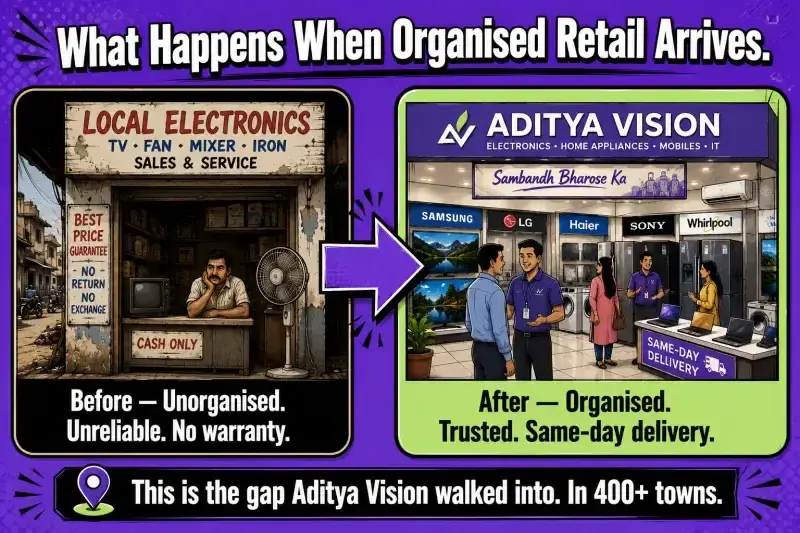
Picture a small town in eastern Uttar Pradesh. Population around two lakhs. One main market road, a cluster of kirana shops, a few clothing stores, and almost certainly a local electronics shop run by someone who has been selling the same brands in the same way for twenty years. The prices are negotiable, the warranty terms are vague, and if something breaks after six months, you are largely on your own.
Now imagine a proper showroom opens up on that same road. In much of Bihar and Uttar Pradesh, that showroom belongs to Aditya Vision. Four thousand square feet. Air-conditioned. Forty brands on display. A trained sales team on the floor. An actual warranty program. Same-day delivery and installation. A helpline you can call if something goes wrong.
That showroom does not just take business away from the local shop. It redefines what buying electronics in that town feels like. For the first time, consumers in that market get the same organized retail experience that someone in a Bangalore or Delhi mall would expect as a basic standard. And they respond to it in a very predictable way. They buy. A lot.
This is the insight that one entrepreneur from Patna identified in 1999 and spent the next twenty-seven years turning into a business that now stretches across four states, serves roughly 30% of India's total population, and has compounded revenue at 29% annually for a decade.
The company we are about to discuss today is Aditya Vision Limited.
The Idea That Everyone Else Ignored
Most consumer electronics retailers in India have followed the same playbook for thirty years. Find the densest, most affluent markets. Open in premium malls or high streets in Tier-1 cities. Compete aggressively on price against every other chain doing the same thing in the same locations.
Aditya Vision did the opposite. Deliberately.
The company identified what it calls the Hindi Heartland: Bihar, Jharkhand, Uttar Pradesh, and Chhattisgarh. States that national retailers largely ignored because the per-capita income looked lower, the infrastructure looked harder, and the consumer seemed less valuable on paper. States that together account for roughly 30% of India's total population.
What the numbers did not show was the underlying dynamic. These were economies in the early stages of electrification and income growth. Households buying their first refrigerator, their first air conditioner, their first television. First-time buyers do not comparison shop the way experienced urban consumers do. They go to the store they trust. And because organized retail was almost entirely absent in these markets, the first credible player to show up and do the job properly had an enormous first-mover advantage.
Aditya Vision showed up first. Then it did the job properly. Then it held the ground.
"The most important thing to do if you find yourself in a hole is to stop digging." Warren Buffett
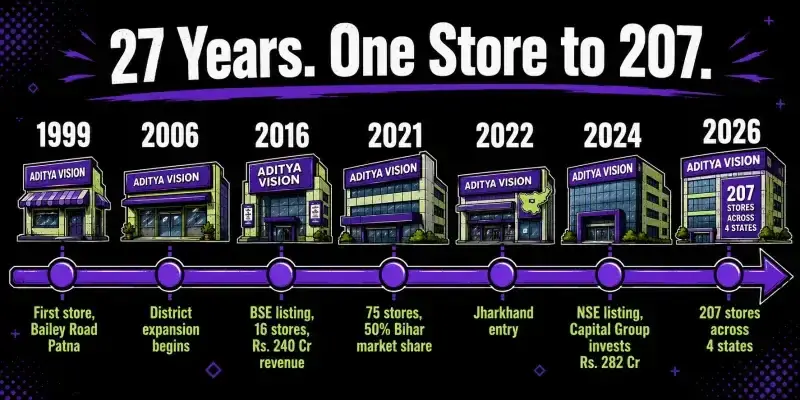
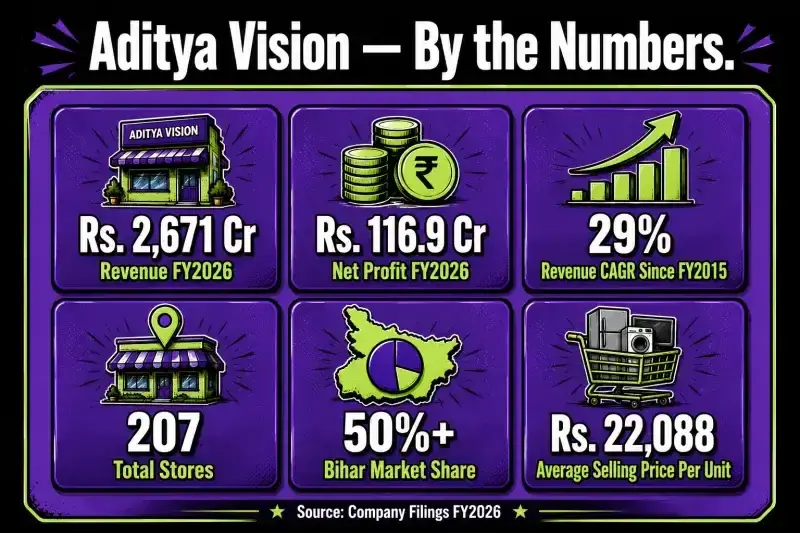
The company currently operates 207 stores. Bihar alone has 118 of them. Uttar Pradesh has 53. Jharkhand has 33. Chhattisgarh has 3, with Madhya Pradesh on the roadmap for FY2027. In Bihar's organized multi-brand electronics retail segment, Aditya Vision holds over 50% market share. When it entered Jharkhand in 2022, it captured the largest organized market share in the state within twelve months.
These are not the numbers of a company that got lucky. They are the numbers of a business that picked the right market, executed consistently, and built something genuinely difficult to dislodge.
The Man Who Spent Six Years in a Single Store
Yashovardhan Sinha was a public sector banker for two decades at Punjab National Bank before he opened the first Aditya Vision outlet on Bailey Road in Patna in 1999. That background matters more than it might seem.
A banker thinks differently from a merchant. A banker thinks about credit structures, payment cycles, trust, and long-term customer relationships. Those instincts shaped how Aditya Vision was built from day one.
Here is the part of the founding story that most people skim past. Between 1999 and 2005, Aditya Vision operated exactly one store. For six years, the company did not open a second location. Instead, Sinha and his team spent those six years studying. Consumer purchasing habits in Bihar. Local credit structures. Seasonal demand patterns. How people in these markets decided to buy expensive items. What they needed to feel confident handing over a significant sum of money to a retailer they had just met.
That six-year study period looks like inaction from the outside. It was the opposite. It was the foundation on which everything that came after was built.
"Investing is not nearly as difficult as it looks. Successful investing involves doing a few things right and avoiding serious mistakes." John Bogle
By 2006, the infrastructure investment thesis was clear. Heavy state spending on rural grid electrification was about to trigger a massive wave of first-time appliance buyers across Bihar and surrounding states. A family that just got reliable electricity for the first time does not ask whether they want a refrigerator. They already know they want one. The question is where they are going to buy it. Aditya Vision was positioned to be the answer.
The district-wide expansion began. By 2021, the company had 75 stores and over 50% market share in Bihar's organized segment. By 2026, it had 207 stores across four states. A family business from Patna, now a genuine regional powerhouse.
The current leadership team reflects the same long-term thinking. Yashovardhan Sinha remains Chairman and Managing Director with a 40.88% personal stake. His daughter Yosham Vardhan, who spent nine years as a cross-border mergers and acquisitions partner at a top Mumbai law firm before joining the family business, now leads procurement, sales, corporate strategy, and investor relations. The combination of founder instinct and professional execution is a particularly powerful one in Indian small-cap businesses, and Aditya Vision has it.
How Aditya Vision's Business Actually Works
The mechanics of how Aditya Vision runs its stores are considerably more interesting than the surface-level description of "electronics retailer" suggests.
Start with sourcing. Eighty-five percent of Aditya Vision's inventory is sourced directly from original equipment manufacturers. LG, Samsung, Sony, Apple, Daikin, the global brands themselves. The remaining 15% goes through distributors. No private labels, no house brands. This is a deliberate choice that serves two purposes. Direct sourcing improves margins by cutting out the distributor's take. And keeping no private labels means every global OEM sees Aditya Vision as a neutral, collaborative partner rather than a potential competitor. That relationship quality pays dividends in ways that are hard to quantify but easy to see in how brands treat the company.
The cash-and-carry model means trade receivables are essentially zero. Payment is received at the point of sale, either in cash, through digital transfer, or through consumer financing arranged by third parties. In a business that relies on working capital to fund inventory, having no debtors is a structural advantage that compounds quietly over time.
The store unit economics are genuinely impressive. Average store size is around 4,250 square feet. Capital expenditure per store runs between Rs. 80 and 90 lakhs. Working capital requirement per store is Rs. 2.75 to 3.00 Crore, primarily for inventory. Stores reach break-even within six to twelve months of opening, compared to eighteen to twenty-four months for national peers like Croma or Reliance Digital. The full payback period is approximately three years. Revenue per square foot reached Rs. 41,000 in FY2026 and annual sales productivity per employee stood at Rs. 1.11 Crore.
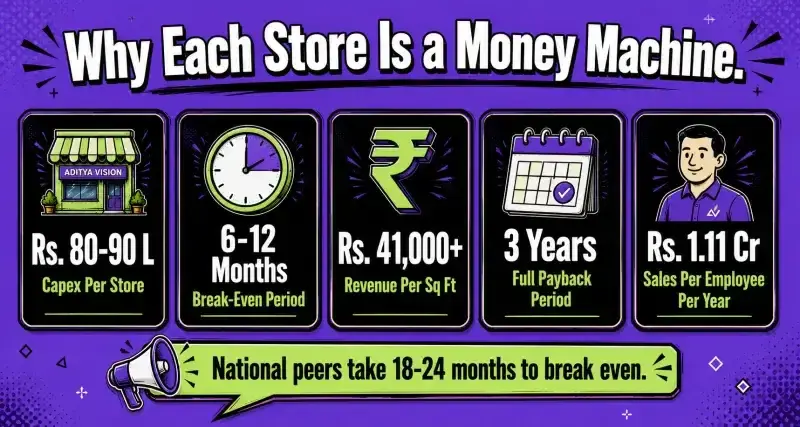
Those numbers make sense when you understand the market dynamics. In Tier-3 and Tier-4 towns, Aditya Vision does not face the brutal price competition that national chains face in metros. Local competition is largely unorganized. National chains do not have the logistics reach to serve these markets. So Aditya Vision can sell premium appliances at or near the minimum operating price set by OEMs, which often means prices in remote towns are actually higher than in competitive metro markets, while the cost base is dramatically lower. Higher realizations, lower overheads, wider margin spread.
Read High Promoter Holding: What It Signals to understand how the ownership structure of companies like Aditya Vision signals long-term management intent.
The Operational Details Nobody Talks About
The surface-level business model is easy to understand. The operational depth beneath it is what separates Aditya Vision from a standard retail chain.
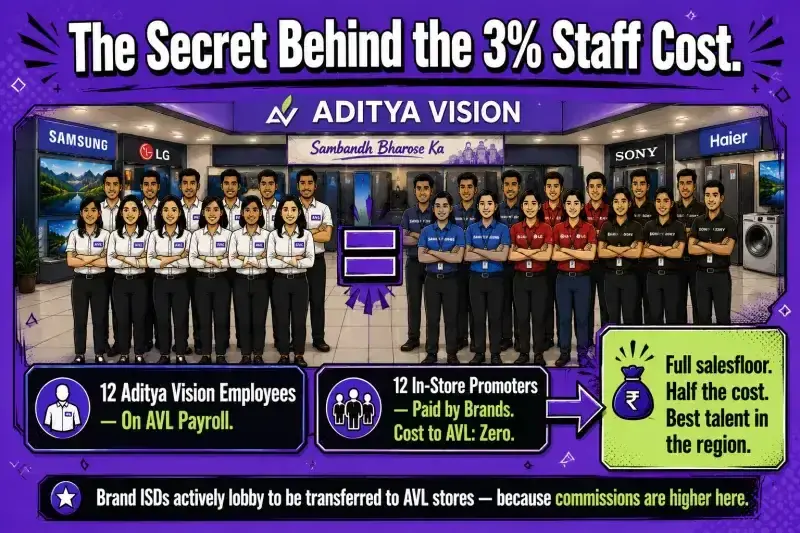
Take staffing. A typical Aditya Vision showroom has around twenty to twenty-four people on the floor. Only ten to twelve of them are Aditya Vision employees. The other ten to twelve are In-Store Promoters paid directly by global brands like Samsung, LG, and Sony. These brands station their own salespeople inside AVL showrooms because the stores generate enough volume to justify it. The result is that Aditya Vision gets a fully staffed salesfloor with roughly half the staff cost absorbed by the brands themselves. Employee wages work out to about 3% of sales per store. That is extraordinarily lean for a retail operation.
The twist is that this creates a self-reinforcing talent dynamic. Because Aditya Vision showrooms generate huge sales volumes, the performance bonuses that brand-paid ISDs earn at AVL locations are significantly higher than what they earn at competing stores. So brand-employed salespeople at rival outlets actively lobby their employers to transfer them to AVL stores. Aditya Vision gets the best brand-trained talent in the region, at no cost to itself, through an organic pull mechanism.
Inventory management is equally sharp. Any product that sits in an Aditya Vision warehouse for more than sixty days is flagged as "high alert." Store managers are immediately notified, and the sales team is directed to actively steer customer conversations toward those specific products. It is not a discount mechanism. It is a floor-level behavioral redirect that moves slow stock before it becomes a problem, without eroding headline margins.
Then there is Aditya Seva, the company's after-sales helpline, which does something that sounds almost counterintuitive. It takes calls and arranges technician visits for any consumer electronics product, including items purchased from competitor stores or e-commerce platforms. A customer whose Samsung TV bought on Flipkart has stopped working can call Aditya Seva and get it fixed. That customer, who had no relationship with Aditya Vision until they had a problem, now has one. And the next time they need to buy something, they go to the store that helped them when they had nowhere else to turn.
Trust is the product. Everything else is how it gets delivered.
"It takes 20 years to build a reputation and five minutes to ruin it." Warren Buffett
The Numbers Behind the Story
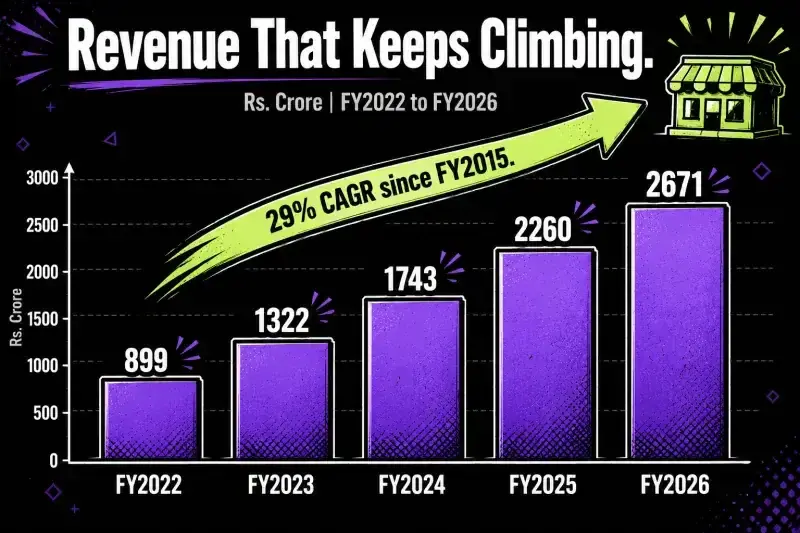
From FY2022 to FY2026, Aditya Vision grew revenue from Rs. 899 Crore to Rs. 2,671 Crore. That is just under three times the top line in four years. PAT grew from Rs. 35.3 Crore to Rs. 116.9 Crore over the same period.
The five-year revenue CAGR going back to FY2015 is 29%. Sustained, not episodic.
Understanding what drives a retail company's return ratios is essential before evaluating whether the growth is genuinely value-creating. Read What is Return on Equity? Why it Matters for Investors to build that lens before reading any retail financial.
Gross margins have held structurally stable in the 15% to 16% range. Operating EBITDA margins compressed slightly from 9.0% in FY2025 to 8.5% in FY2026. Management attributed this to two factors. First, a product mix shift: digital gadgets like smartphones and laptops now account for 24% of sales, and these categories carry lower gross margins than large appliances like ACs and refrigerators. Second, the aggressive expansion into western Uttar Pradesh and Chhattisgarh brought pre-operating gestation costs that hit the P&L before the new stores had time to mature.
Neither of these is a structural deterioration. Product mix will stabilize. New stores will move through their gestation period. Same-store sales growth, which held at 14-15% annually for several years, did slow to 8% in FY2026, and that is worth watching. But the trajectory from a single store in Patna to 207 stores across four states, compounding at 29% for a decade, is not a story that changes because one year's SSSG comes in lower than usual.
The balance sheet is clean. In FY2024, net debt-equity stood at 0.02 times. Capital raised through institutional investment has been deployed to eliminate short-term borrowings rather than fund dividends or promoter exits. Return on Invested Capital and Return on Capital Employed have consistently sat in the 17% to 28% range over the cycle.
In August 2024, the company executed a 10:1 stock split, reducing face value from Rs. 10 to Rs. 1. FY2026 diluted EPS on the post-split basis stands at Rs. 9.05.
Read How to Read a Profit and Loss Statement to build the foundation for reading retail financials like these with confidence.
The Institutional Validation
In 2024, something changed in how the market looked at Aditya Vision. The company raised Rs. 282.42 Crore via a preferential share allotment to Capital Group, one of the world's largest foreign institutional investors, managing over $2 trillion in assets. Capital Group does not invest in small regional retailers as a casual allocation. When a fund of that scale writes a cheque of that size into a company this size, it has done substantial diligence on the business quality, the management team, and the runway ahead.
That capital was deployed sensibly. Short-term debt was repaid. Inventory buffers were established. Expansion capex was funded from internal accruals rather than borrowings.
The institutional base has since grown. Mutual funds now hold 18.97% of the company and FIIs hold 16.18%, for a combined institutional holding of over 35%. That is meaningful validation from capital allocators who had their choice of opportunities and chose this one.
There is also a historical context worth understanding. In September 2021, promoter shares pledged as collateral stood at 40.71% of the promoter group's entire holding. That was a genuine risk overhang. The elimination of that pledge, achieved through the Capital Group raise and the resulting debt repayment, transformed the balance sheet story entirely. Promoter holding did drop by roughly 20% over three years as a result of the equity issuances, but the trade was rational: replace high-interest debt and pledge risk with blue-chip institutional capital and a clean balance sheet.
Promoter holding now stands at 47.14%, with Yashovardhan Sinha personally holding 40.88%. The pledge is zero.
"Wide diversification is only required when investors do not understand what they are doing." Warren Buffett
The Road Ahead: How Big Can This Get?
An independent market study by ICICI Securities mapped the total organized market potential across the five key target states: Uttar Pradesh, Bihar, Jharkhand, Chhattisgarh, and Madhya Pradesh. The analysis identified 1,328 viable store catchment areas across these states. Current total organized retail presence across all players in these markets stands at roughly 404 showrooms, representing organized penetration of around 30%.
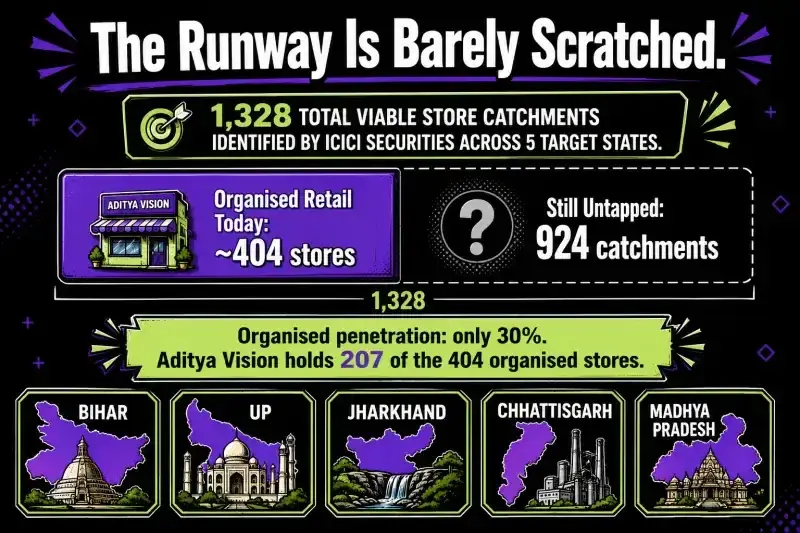
Aditya Vision has 207 of those 404 stores. Over half the organized retail presence in its target geography, already.
And the market is less than a third penetrated.
Management has guided 30 to 35 new store openings annually over the next two to three years. At that pace, the company will have somewhere between 270 and 310 stores by FY2028. Madhya Pradesh entry is officially planned for FY2027. Central and Western Uttar Pradesh expansion is ongoing.
The "Vision 2.0" store format is also shifting the quality of the estate upward. Newer stores are being built at 4,000 to 5,000 square feet, larger than the average legacy footprint, and designed around an experiential retail concept: 4K and 8K smart TVs on display, large-capacity smart refrigerators, premium AC configurations. The goal is to shift the average selling price upward as consumer incomes in the Hindi Heartland grow. Average selling price reached Rs. 22,088 per unit in FY2026. Premiumisation and volume growth together is a powerful combination.
Analyst consensus projects revenue growing from Rs. 2,671 Crore in FY2026 to Rs. 3,838 Crore in FY2028. Net profit is projected to grow from Rs. 116.9 Crore to Rs. 196.2 Crore over the same period, implying a 20% to 25% CAGR. EBITDA margins are expected to recover to 8.9% by FY2027 as newer stores mature and the product mix stabilizes.
The company also onboarded actor Pankaj Tripathi as brand ambassador in 2026. In Hindi-speaking states, that is not a celebrity endorsement. That is cultural resonance. Tripathi is one of the most trusted faces in the region. The tagline "Sambandh Bharose Ka," a relationship built on trust, and the face chosen to carry it are perfectly aligned.
Read Micro-Cap Investing: Where Extraordinary Wealth Is Built (and Tested) to understand the framework for evaluating companies like Aditya Vision before they become widely known.
The Risks That Deserve Honest Attention
Same-store sales growth slowing to 8% in FY2026 from a sustained 14-15% in prior years is the number that deserves the most scrutiny. Part of this was macro: consumer sentiment in the Hindi Heartland softened under cost-of-living pressures and uneven monsoon impacts on rural income. Part of it was the store base maturing, as older Bihar stores run out of easy first-time buyer demand in their catchments. Whether SSSG recovers as new geographies contribute, or whether it has structurally decelerated, will determine how the next few years play out.
Product mix pressure is real. Digital gadgets now account for 24% of revenue and that share is growing. Smartphones and laptops are inherently lower-margin categories than the large appliances that originally built the business. If the mix continues shifting toward gadgets faster than the company can offset with premiumisation in large appliances, gross margins will face ongoing pressure.
E-commerce is the structural question nobody has a definitive answer to yet. National platforms like Amazon and Flipkart have significant limitations in servicing Tier-3 and Tier-4 towns: last-mile delivery complications, no installation support, no credible after-sales structure, and no physical presence for consumers who want to see what they are buying before committing. Aditya Vision's advantages in these markets are real today. Whether they remain real as logistics infrastructure in smaller towns improves is a question that will unfold over five to ten years, not one or two.
Valuation is the final consideration. This is not a cheap stock by conventional metrics. The growth story is well-understood by analysts and the institutional base that has already arrived. Investors entering now are paying for continued execution on a runway that is large but not guaranteed to be captured at the pace implied by current estimates.
The historical float risk is worth noting too. For much of 2020, the entire public shareholder base of Aditya Vision was in the double digits, leaving the stock extremely illiquid. That has changed dramatically with institutional entry and the stock split. But understanding the liquidity history of a counter before sizing a position is always good practice.
Explore our Products
Research Framework

Emerging Titans
Combination of quantitative analysis, industry tailwinds, and management assessment - SPRINT investment philosophy

Tiny Titans
Heavy emphasis on scuttlebutt research, plant visits, and early on-ground signals
What Aditya Vision Really Is
Here is the simplest way to think about this business.
India has roughly 650,000 villages and thousands of Tier-3 and Tier-4 towns. Most of them are in the process of going through an economic transition that Mumbai and Bangalore went through fifteen to twenty years ago. First-generation salaried workers. First-time appliance buyers. Families moving from unorganized, unreliable local shops toward organized retail as incomes rise and aspirations follow.
Aditya Vision is the organized retailer that gets there first, earns the trust of those first-time buyers, and then becomes the default destination for every subsequent purchase that family makes over the next two decades. The first sale is a refrigerator. The next one is an AC. Then a washing machine. Then a television upgrade. Then a smartphone for each child as they enter college. A customer acquired at the beginning of a family's income journey is worth far more than the first transaction suggests.
This is not a particularly glamorous business. There is no proprietary technology. No patents. No R&D pipeline. Just excellent retail execution in markets that most competitors wrote off as too small, too difficult, or too far from a major city to be worth the effort.
That willingness to go where others would not, backed by twenty-seven years of trust-building and a management team that thinks in decades rather than quarters, is what makes this business genuinely interesting.
The Hindi Heartland is not a niche market. It is 30% of India. And it is just getting started.
"In the business world, the rearview mirror is always clearer than the windshield." Warren Buffett
Read Small Cap Stocks: How to Find Hidden Gems Before the Crowd Does to sharpen the framework for finding businesses with this kind of structural runway before they become mainstream investment conversations.
This article is intended for educational and informational purposes only and should not be construed as financial advice. Please consult a registered investment advisor before making any investment decisions.
FAQs
What does Aditya Vision sell and where does it operate?
+Aditya Vision is a multi-brand consumer electronics and home appliances retail chain operating across Bihar, Jharkhand, Uttar Pradesh, and Chhattisgarh. It sells large appliances like air conditioners, refrigerators, and washing machines, digital gadgets including smartphones and laptops, and small appliances across 207 stores as of 2026. The company sources 85% of its inventory directly from global OEMs like LG, Samsung, Sony, Apple, and Daikin, with the remaining 15% coming through distributors. Bihar alone accounts for 118 of its stores, where the company holds over 50% market share in the organised multi-brand electronics retail segment.
Why does Aditya Vision focus on smaller towns instead of competing in metros?
+The business model is built around a structural insight that most national retailers missed. In Tier-2, Tier-3, and Tier-4 towns across the Hindi Heartland, organised retail is almost entirely absent. National chains like Croma and Reliance Digital focus on premium urban real estate, leaving smaller markets served only by unorganised local shops with no warranties, no after-sales service, and inconsistent pricing. Aditya Vision walks into these markets as the first credible organised retailer and immediately captures first-time buyers who have no real alternative. Real estate and staff costs are dramatically lower in these towns, while selling prices can be maintained at or near OEM-set minimum operating prices because there is no competitive pressure to discount. The result is wider margin spreads than most metro-based retailers achieve despite lower absolute transaction values.
What is the ISD model and why does it matter for Aditya Vision's profitability?
+In-Store Promoters are sales staff appointed and paid directly by global brands like Samsung, LG, and Sony, who are stationed inside Aditya Vision showrooms. A typical AVL store has around 20 to 24 people on the floor, of which only 10 to 12 are actual Aditya Vision employees. The other 10 to 12 are brand-funded ISDs whose salaries and incentives are entirely on the brand's payroll. This arrangement keeps Aditya Vision's employee cost at approximately 3% of sales per store, which is extraordinarily lean for a retail operation. Because AVL stores generate high sales volumes, the performance bonuses these brand-paid ISDs earn are significantly higher than at rival stores, which means brand salespeople at competing outlets actively lobby to be transferred to AVL locations. Aditya Vision gets the best trained retail talent in the region at zero incremental cost to itself.
What is Aditya Seva and how does it help Aditya Vision acquire customers?
+Aditya Seva is Aditya Vision's after-sales helpline, but its real purpose goes beyond serving existing customers. The helpline accepts calls and arranges technician visits for any consumer electronics product, including items purchased from competitor stores or e-commerce platforms. A customer whose television bought on Amazon or from a local shop has stopped working can call Aditya Seva and get the issue resolved. That customer, who had no prior relationship with Aditya Vision, now has one built on a genuinely helpful experience. The next time they need to buy an appliance, they go to the store that helped them when they had nowhere else to turn. It is a low-cost trust-building and customer acquisition mechanism that converts frustrated buyers from competing channels into loyal, repeat Aditya Vision customers.
Who are the promoters of Aditya Vision and how is the company governed?
+Aditya Vision was founded in 1999 by Yashovardhan Sinha, a former Punjab National Bank banker with two decades of financial services experience. He remains Chairman and Managing Director today with a personal stake of 40.88%. His daughter Yosham Vardhan, who spent over nine years as a cross-border mergers and acquisitions partner at a top Mumbai law firm, now leads procurement, sales, corporate strategy, and investor relations. The promoter group collectively holds 47.14% of the company with zero pledged shares, a significant improvement from September 2021 when 40.71% of the promoter holding was pledged as collateral. The board also includes Ravinder Zutshi as an Independent Director, an industry veteran with 45 years of experience including 19 years as Deputy Managing Director of Samsung India.
How large is the market opportunity for Aditya Vision going forward?
+An independent market study by ICICI Securities identified 1,328 viable store catchment areas across Aditya Vision's five key target states: Uttar Pradesh, Bihar, Jharkhand, Chhattisgarh, and Madhya Pradesh. Total organised retail presence across all players in these markets currently stands at around 404 showrooms, representing organised penetration of roughly 30%. Aditya Vision holds 207 of those 404 stores, giving it over half the organised retail presence in its own target geography. Management has guided 30 to 35 new store openings annually over the next two to three years, with Madhya Pradesh entry planned for FY2027. Analyst consensus projects revenue growing from Rs. 2,671 Crore in FY2026 to Rs. 3,838 Crore in FY2028, implying a 20% to 25% CAGR driven by store additions and operating leverage as newer stores mature.

High growth stock specialist, Value Educator
Shashank Mahajan is an equity research professional with over 12 years of experience in identifying high-potential SME and micro-cap stocks at an early stage. He follows a rigorous scuttlebutt research–driven approach, combining on-ground insights with deep financial analysis. Shashank specializes in uncovering under-researched and under-owned companies with strong management quality and long-term growth potential. Through disciplined research and early identification, he focuses on spotting tomorrow’s market leaders before they enter the mainstream investor radar.

Zen Technologies: Revenue Fell After a Big Win




PNG Jewellers: A 194-Year-Old Name Goes National

Explore our Products
Research Framework
Emerging Titans
Combination of quantitative analysis, industry tailwinds, and management assessment - SPRINT investment philosophy
Tiny Titans
Heavy emphasis on scuttlebutt research, plant visits, and early on-ground signals


 Orders
 Subscription
 Share with friends


Required Details
₹23999.00
(12 month subscription)
As per SEBI regulations, all users are mandated to complete the KYC that is validated for 1 year. Post payment, you will be redirected to the KYC screen


No comments yet. Be the first to comment!