A missile does not become powerful because of the metal that surrounds it. An aircraft does not fly because of the logo painted on its fuselage. And a radar does not become strategically important simply because it can detect something hundreds of kilometres away.
Behind every major aerospace and defence platform sits a much less visible network of companies making the components, electronics, sub-assemblies and systems that have to work perfectly when everything else is under pressure. Sigma Advanced Systems is one of these companies.
These businesses rarely receive the attention given to aircraft manufacturers, missile developers or defence majors. Yet once their products become part of a critical programme, they can become surprisingly difficult to replace. Years of engineering, testing, qualification and co-development create relationships that can last for decades. In many cases, the supplier is not merely selling a component anymore; it has become part of the customer's engineering ecosystem.
That is where one relatively understated Indian company has been quietly positioning itself.
For more than three decades, its roots were firmly planted in India's defence ecosystem. It built specialised electronics and mission-critical subsystems, developed relationships with defence customers and gradually expanded its engineering capabilities. But over the last few years, the ambition has changed.
The company began moving beyond its traditional role, entering naval and avionics systems, investing in counter-drone technology and, most importantly, acquiring businesses that could take it directly into the global aerospace and defence supply chain.
The transformation became particularly significant when it acquired UK-based Nasmyth. Suddenly, a company whose history was largely connected with India's defence programmes had access to a business supplying complex aerospace components and sub-assemblies into global programmes. The acquisition of AS Strategic then added another layer: access to European defence markets through strategic partnerships and joint ventures.
The result is a business that looks very different from the one that existed only a few years ago.
This is the story of Sigma Advanced Systems Limited — and more importantly, the story of what Sigma is trying to become.
Sigma Advanced Systems: From a Niche Defence Business to a Much Larger Platform
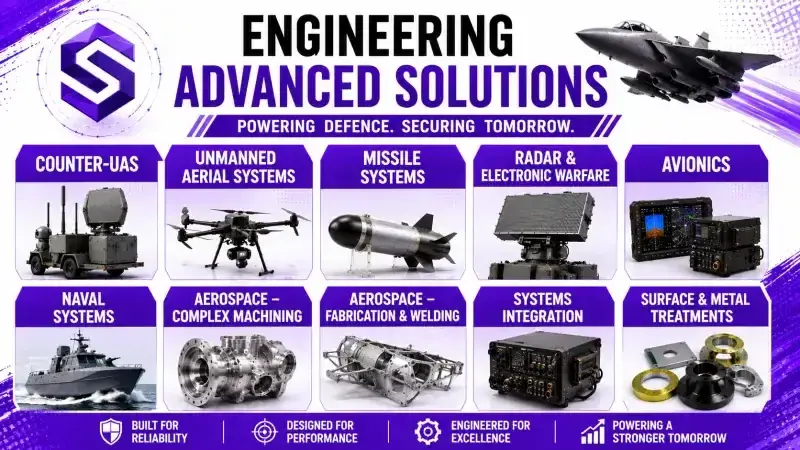
Sigma's evolution becomes easier to understand when viewed as a sequence of strategic moves rather than as a collection of acquisitions. The original business was primarily positioned around defence electronics and build-to-spec engineering. Its capabilities included missile guidance systems, radar and electronic warfare systems, avionics, naval subsystems and other mission-critical electronics. The company also maintained long-standing relationships with India's defence ecosystem, including defence PSUs and the armed forces.
The significance of this business model lies in the word "build-to-spec." Sigma is not merely producing standard components against a catalogue. It participates in programmes where the customer defines a demanding technical requirement and the supplier develops, engineers and manufactures the required system or subsystem. This creates a deeper relationship than conventional contract manufacturing because the supplier's engineering team becomes part of the product-development process.
Over time, Sigma expanded beyond its traditional defence-electronics base. It strengthened Field-Programmable Gate Array (FPGA) and system-on-chip capabilities, invested in Indrajaal to participate in autonomous systems and counter-drone solutions, and expanded into naval and avionics applications. The strategic investment in Indrajaal was particularly important because it gave Sigma exposure to AI-led counter- (Unmanned Aircraft System) UAS products, surveillance drones, armed UAVs and proprietary technologies such as SkyOS, WeaponFusion and HyperMind Computing.
But the bigger change came from the other side of the value chain.
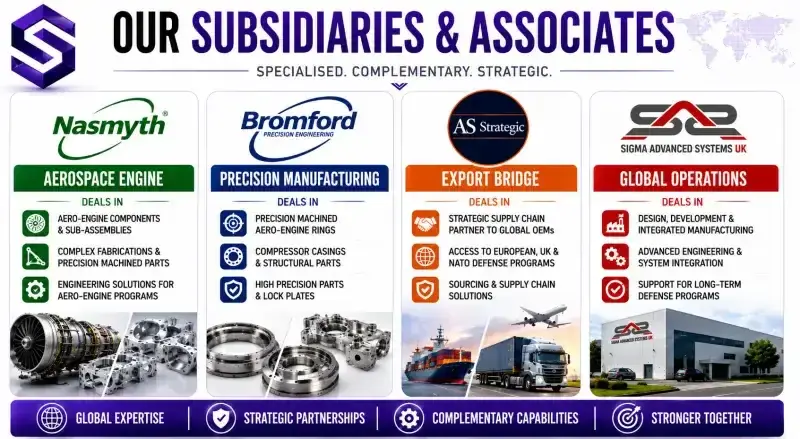
In October 2025, Sigma acquired 100% of UK-based Nasmyth, taking the company into aerospace components and sub-assemblies while simultaneously giving it access to UK and European aerospace markets. In April 2026, it acquired 51% of AS Strategic, adding another layer of international market access through relationships and joint ventures with European defence primes. In July 2026, it acquired 100% stake in Bromford Precision Solutions Limited, incorporated in the United Kingdom, a leading Aerospace and Defence manufacturer supplying specialised complex aero engine rings and engine structures directly to leading OEMs in the UK and Europe.
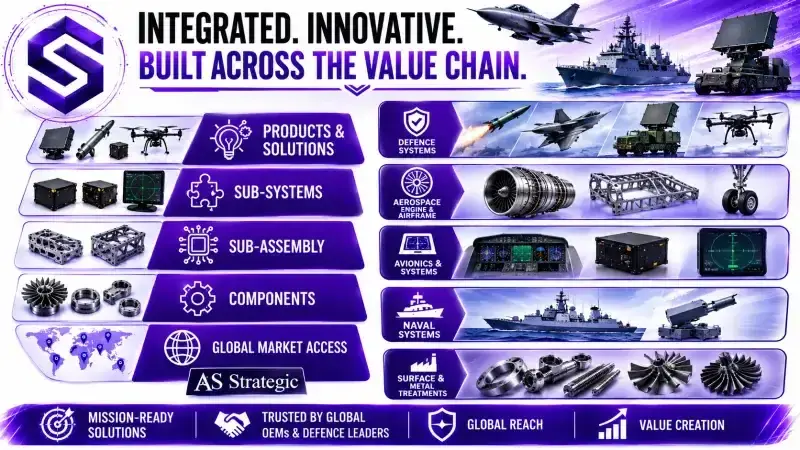
This matters because aerospace and defence supply chains are highly fragmented by capability. One company may possess the design capability, another the machining capability, another surface-treatment expertise and another the customer qualification. Sigma is attempting to bring several of those layers under one umbrella.
Nasmyth provides the precision-manufacturing bridge. It is a Tier-1 supplier to global aircraft and aero-engine OEMs, with capabilities covering precision machining, metal treatments, complex fabrication and assemblies. Its product portfolio includes components for aero-engines and airframes, with exposure to platforms such as the Trent engine family, TP400, UltraFan, EJ200, V2500, B787, Eurofighter, A350, F-35, Gripen and A320. Its revenue mix is approximately 75% commercial and 25% defence.
AS Strategic, meanwhile, plays a different role. It provides access to European defence markets through partnerships and joint ventures, with Sigma holding a first right on workshare in the operating model presented by the company. The strategic opportunity is straightforward: AS Strategic can originate international programmes, while Sigma can increasingly provide the manufacturing capability required to execute them.
This is the first important investment insight - The acquisitions are not simply intended to add revenue, they are intended to change where Sigma sits in the aerospace and defence value chain.
The Moat Is Not the Factory- It Is the Qualification
Aerospace and defence manufacturing can look deceptively similar to other engineering businesses from the outside. There are CNC (Computer numerical control) machines, fabrication shops, engineers and production lines. But the economics are fundamentally different because the cost of failure is extraordinarily high.
Like this analysis? Get powerful insights like this every week. No spam.
The manufacturing infrastructure behind this strategy is equally important, particularly as India becomes a larger base for precision engineering. Our analysis of The Precision CNC Machine Manufacturer Benefiting from India’s Manufacturing Capex Cycle looks at this opportunity in greater detail.
An aircraft engine component cannot simply be replaced by a cheaper supplier because another factory has spare capacity. A missile subsystem cannot be substituted overnight because the procurement department found a lower quotation. The new supplier has to demonstrate technical capability, quality systems, process consistency and reliability, after which the component or subsystem may have to undergo extensive qualification.
Sigma has multi-decade customer relationships, participation in critical programmes, dominant or single-source positions in several programmes, switching cycles of more than four years and remaining platform lives of 15–20 years or more for a majority of active platforms.
This is a powerful form of customer stickiness. It is not contractual stickiness in the conventional sense. It is qualification-driven switching cost.
This kind of structural advantage is often what separates a durable business from a company competing purely on price. For a deeper look at how such advantages protect businesses over time, read Economic Moat Explained: Why Some Companies Stay Dominant for Decades.
This kind of structural advantage is often what separates a durable business from a company competing purely on price. For a deeper look at how such advantages protect businesses over time, read Economic Moat Explained: Why Some Companies Stay Dominant for Decades.
Consider what happens when an aerospace OEM has already approved a supplier. The supplier has invested in tooling, engineering documentation, process validation and quality systems. The customer has invested time in audits, testing and qualification. Both sides therefore have an economic incentive to continue the relationship unless performance deteriorates materially.
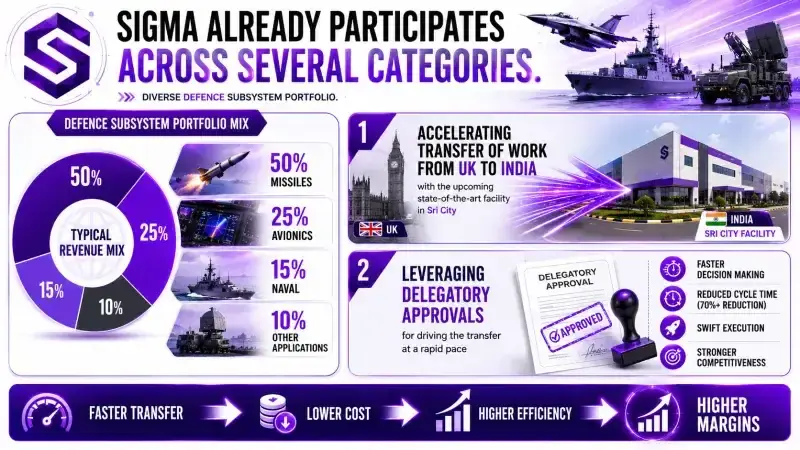
This explains why Sigma's international expansion could be more valuable than simply adding another export market. Nasmyth already possesses more than five decades of manufacturing experience and relationships with global aerospace customers. More importantly, Nasmyth has delegatory approvals that allow work to be transferred to India.
That approval is potentially more valuable than a new machine.
The reason is simple. Moving production from the UK to India can materially lower manufacturing costs, but only if the customer allows it. In a conventional manufacturing business, shifting production might simply require replicating the process. In aerospace, the customer must be comfortable that the new facility, processes and quality controls meet the required standards.
Sigma's delegatory approvals reduce this friction. Management's indicated that certain work can be transferred from Nasmyth's UK facilities to India, where the company expects materially higher manufacturing margins. The strategic objective is therefore not to hollow out the UK business, but to use the UK customer relationship and approvals as the front end while increasingly using India's lower-cost manufacturing base for eligible work.
The economics become particularly interesting when the two sides are combined.
Indian manufacturing for Nasmyth-related work can generate EBITDA margins of roughly 20–24%, while Nasmyth's UK operations operate around 12–15%, resulting in a consolidated margin potential of roughly 17–20% depending on the work mix.
That is the beginning of a genuine cost advantage.
The second element of the moat is engineering depth. Sigma's defence business is not limited to manufacturing. Its portfolio includes missile subsystems, radar, electronic warfare, avionics and naval systems, while its IP-led businesses are moving into autonomous systems and counter-drone applications. The company therefore has the possibility of moving up the value chain from manufacturing components towards owning more of the system-level intellectual property.
The third element is customer access. AS Strategic adds relationships with European defence primes and global OEMs, while Nasmyth already provides entry into major aerospace programmes. The combination creates a potentially reinforcing loop: international customer access generates orders; Sigma's Indian manufacturing capability lowers the cost of execution; improved economics support competitive bids; successful execution strengthens customer relationships; and those relationships create opportunities for additional programmes.
That is a much stronger moat than simply owning production capacity.
Be part of the
Value Educator
community
Get exclusive insights tailored to
sharpen your investment decisions.
The Financials Validate the Transformation - But They Also Require Caution
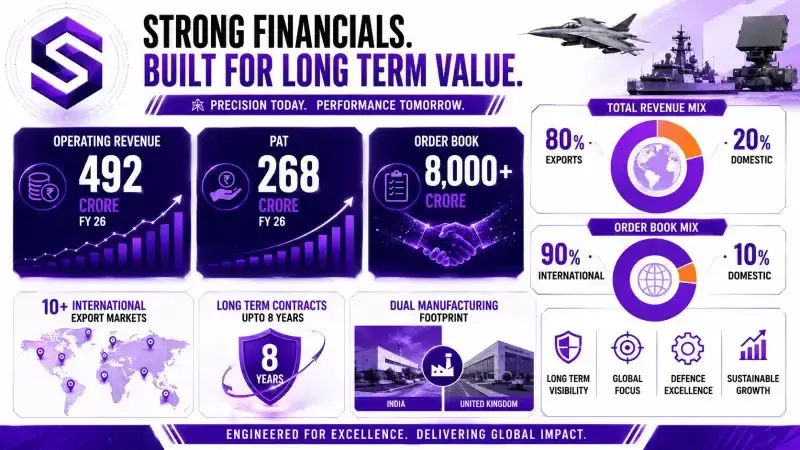
At first glance, Sigma's FY26 financial numbers appear almost too good to be true. Consolidated revenue from operations reached ₹492 crore, while total revenue including other income was ₹788 crore. Profit before tax stood at ₹299 crore and reported net profit at ₹268 crore. In Q4 alone, revenue from operations was ₹323 crore and reported net profit was ₹128 crore.
The temptation would be to extrapolate those numbers directly into the future. That would be a mistake.
The first thing an investor should separate is operating revenue from other income. In Q4 FY26, the company reported ₹323 crore of revenue from operations and ₹91 crore of other income, taking total revenue to ₹413 crore. For FY26, operating revenue was ₹492 crore, while other income was ₹296 crore. In other words, a substantial portion of the headline FY26 revenue and profit came from items outside recurring manufacturing operations.
This distinction becomes critical when evaluating the quality of earnings. The more useful number for understanding the operating business is therefore revenue from operations and operating EBITDA.
This tells us something important about the future business mix. Sigma's original defence business is relatively high margin because it is built around engineering, specialised subsystems and development work. Nasmyth, by contrast, is a much larger manufacturing business but operates at lower margins in its current UK configuration. The opportunity is therefore not merely to grow Nasmyth; it is to improve Nasmyth's economics while allowing Sigma's higher-margin business to scale alongside it.
The standalone Sigma business historically operated around a 25% EBITDA margin, while Nasmyth's margin can improve through greater utilisation of lower-cost Indian manufacturing and efficiency improvements in UK facilities. AS Strategic's outsourced business currently carries margins in the 10-12% range, but management expects margins to rise towards 20–25% as manufacturing moves in-house.
That creates a potential operating-leverage story.
The balance sheet, however, shows why execution matters. At 31 March 2026, Sigma had total assets of ₹1,059 crore, equity of ₹468 crore, non-current liabilities of ₹136 crore and current liabilities of ₹455 crore.
That is not inherently alarming for a company undergoing a rapid transformation, but it changes the investment debate. Growth is no longer simply a question of whether customers want Sigma's products. The company must convert orders into production, production into receivables, receivables into cash and acquisitions into returns on invested capital.
This is why reported PAT should be treated as a poor shorthand for future earnings. The real test will be whether operating revenue compounds without requiring a proportionate increase in working capital and whether EBITDA growth begins to translate into operating cash flow.
This is ultimately a cash-conversion question, and it is one of the most important things investors should track beyond reported profit. For a deeper understanding, see Cash Flow Statement Explained: The Most Honest Financial Report.
If those two things happen simultaneously, the transformation becomes much more credible. If revenue grows rapidly but cash remains trapped in inventory and receivables, the headline growth will be far less valuable.
Join 1,45,000+ investors discovering under-researched small caps before they rerate.
The Next Margin Expansion Is Hidden Inside the Supply Chain
The most interesting part of Sigma's story may not be the orderbook itself. It may be what happens to the economics of the existing orderbook.
A large orderbook can create the illusion of safety, but investors should ask a more important question: At what margin can the orderbook be executed?
Sigma's answer is increasingly linked to geographic arbitrage.
Nasmyth currently operates several manufacturing facilities in the UK. These facilities possess advanced machining, fabrication, grinding, treatment and assembly capabilities, but the UK has a structurally higher manufacturing cost base than India. Sigma is attempting to retain customer ownership and high-value processes in the UK while shifting eligible manufacturing work to India.
The company has already built the infrastructure required for this strategy. Its Sri City facility is designed around precision machining, controlled material storage, traceability and an AS9100 - aligned quality management framework. The larger master plan covers approximately 23 acres and 2.5 lakh sq. ft., providing room for future expansion.
The implications are significant.
Suppose a component is currently manufactured in the UK at a relatively modest margin. If the customer allows the same machining process to be carried out in India, Sigma can potentially reduce the cost base without sacrificing the customer relationship. Some of that benefit can be retained as margin, while some can be shared with the customer through more competitive pricing. Either way, Sigma becomes a more attractive supplier.
This is particularly important in a business where customer relationships are long-term. Management indicated that the Rolls-Royce relationship is decades old and that Nasmyth is the sole supplier for certain parts. The company therefore has the potential to negotiate additional volumes in exchange for cost reductions generated through Indian manufacturing.
That creates a mutually beneficial proposition rather than a simple cost-cutting exercise.
The UK facilities can focus on complex work, customer engagement, specialised processes and qualification-heavy activities, while India can absorb machining and volume production wherever approvals permit. Over time, the result could be a higher-margin global manufacturing network rather than a collection of geographically separate subsidiaries.
AS Strategic adds another dimension. Its European partnerships provide access to defence programmes that Sigma would have found difficult to originate independently. The company's Q4 presentation highlights eight active teaming agreements with global OEMs and a strategy of combining international market access with Indian manufacturing capabilities.
The opportunity is therefore larger than simply "export growth".
Sigma is trying to become the manufacturing backend for global aerospace and defence programmes while simultaneously developing its own higher-value defence products and subsystems.
That combination could materially alter its economics.
A pure contract manufacturer tends to compete primarily on cost, delivery and quality. A defence technology company competes on engineering capability and IP. Sigma is attempting to occupy both positions. The manufacturing layer provides scale, while the engineering and IP layer provides margin and differentiation. If the company succeeds, operating leverage should become increasingly visible. Fixed engineering teams, facilities and qualification infrastructure can support larger volumes. Capacity utilisation can improve.
Procurement can become more efficient. UK work transferred to India can carry higher margins. And newly acquired customer relationships can be monetised through Sigma's existing manufacturing base.
That is the mechanism through which today's acquisitions could create tomorrow's profitability.
The Opportunity Is Bigger Than India's Defence Budget
There are two separate growth stories embedded inside Sigma.
The first is India's defence indigenisation cycle.
India remains heavily dependent on imported defence equipment despite being one of the world's largest defence spenders. The company's presentation highlights a defence budget of approximately 7.84 Lakh Crore for FY26, up 15% year-on-year, alongside a large procurement pipeline supported by indigenisation and increasing private-sector participation.
For investors looking at this broader theme, understanding where defence spending, indigenisation and private-sector participation are creating opportunities is essential. We explore this in How to Invest in Defence Sector.
For Sigma's original business, this creates several avenues.
Missile systems require guidance and end-game electronics. Aircraft require avionics and control systems. Naval platforms require specialised electronics. Radar and electronic warfare systems require sophisticated hardware and software. Counter-drone systems are becoming increasingly important as low-cost unmanned systems change the economics of modern warfare.
Sigma already participates across several of these categories. Its defence subsystem portfolio has a typical revenue mix of approximately 50% missiles, 25% avionics, 15% naval and 10% other applications.
The second growth story is international.
This is where Nasmyth and AS Strategic change the addressable market. The global aerospace market is expected to expand materially over the next decade, driven by air travel, fleet replacement, defence spending and technological upgrades.
Sigma does not need to capture a large percentage of that market for the opportunity to matter.
The company is currently operating from a relatively small revenue base. Its FY26 operating revenue was ₹492 crore, which means even a modest number of large international programmes can materially alter the company's scale.
This is already visible in the order pipeline. More than 90% of the orderbook is international and that contracts can extend for as long as eight years. It has an executable orderbook of approximately ₹6,000 crore spread over eight years, alongside a roughly ₹3,800 crore Rolls-Royce order over seven years.
The key point is not the absolute number. It is the quality and duration of visibility. An aerospace programme can continue for years after the initial contract is won. Once a component is qualified and production begins, follow-on orders can continue throughout the programme lifecycle. This makes aerospace fundamentally different from businesses where every year's revenue must be won again through fresh bidding.
The opportunity becomes even more interesting if Sigma can use its Indian manufacturing base to become increasingly competitive in global tenders. India provides a significant cost advantage in engineering and manufacturing manpower, while Sigma's UK presence provides the certifications, customer relationships and programme access needed to overcome the trust barrier.
That combination could become the company's defining competitive advantage.
There is also an adjacency opportunity in defence exports. Sigma's product portfolio includes UAVs, counter-drone systems and other IP-led products. These businesses have potentially higher margins than conventional component manufacturing, although they also carry significantly higher technology and execution risk.
The company therefore has three potential growth engines: scaling the domestic defence business, expanding global aerospace manufacturing and increasing the contribution from proprietary defence technologies.
The first provides a foundation.
The second provides scale.
The third provides optionality.
“The big money is not in the buying or the selling, but in the waiting.” — Charlie Munger
The Risks Are Real — and They Sit in Execution, Not Demand
The bullish thesis is compelling, but the investment case should not be confused with certainty.
The first risk is integration complexity.
Sigma has transformed itself rapidly through acquisitions. Nasmyth, AS Strategic and the existing Indian defence business have different customers, processes, cultures and economics. A group can create value by combining businesses, but it can also destroy value if management becomes overwhelmed by complexity.
The company has attempted to mitigate this by retaining existing management teams and integrating operations gradually. The approach is sensible, but the real test will come as manufacturing is transferred across geographies and as multiple businesses begin sharing facilities, engineering resources and customers.
The second risk is working capital.
Materials must often be purchased well ahead of production, inventory has to meet stringent traceability requirements and customer payment cycles can create substantial receivables. Sigma's working capital increased sharply following the Nasmyth acquisition. If revenue expands rapidly while working capital expands even faster, free cash flow could lag reported EBITDA.
The third risk is execution of the India transfer strategy. Moving work from the UK to India can improve margins, but only after the required certifications, customer approvals and process validation are obtained. The Sri City facility therefore represents both an opportunity and an execution milestone. Delays in certification or customer approval could postpone the expected margin expansion.
The fourth risk is capital allocation. Acquisitions have become central to Sigma's strategy. Management indicated that it generally looks for EBITDA-positive, complementary businesses and has targeted attractive acquisition multiples. That is encouraging, but acquisition-led growth only creates value if the acquired companies generate returns above the cost of capital after integration and incremental investment.
The company therefore needs to prove that its acquisition strategy is repeatable rather than merely exciting.
There is also a valuation risk. The market has already begun recognising the transformation. The stock had appreciated sharply as investors recognised the shift from a small domestic subsystem supplier towards an integrated aerospace and defence platform. Once expectations become high, even strong operational growth may not produce strong shareholder returns if the market has already priced in much of that growth.
Finally, there is the risk that the business becomes too complicated to analyse.
That may sound trivial, but it is not. Investors will increasingly need to distinguish between Sigma's standalone defence business, Nasmyth's UK aerospace operations, Indian manufacturing for Nasmyth, AS Strategic's international business and the IP-led defence portfolio. Reported consolidated numbers can hide differences in margin, capital intensity and cash conversion.
The next phase of the story therefore requires financial transparency as much as operational execution.
Investors should watch operating revenue, EBITDA margin, working capital days, operating cash flow, net debt and return on capital employed much more closely than headline PAT. If operating cash flow begins catching up with EBITDA while margins rise, the thesis strengthens materially. If not, the orderbook alone will not be enough.
“The essence of investment management is the management of risks, not the management of returns.”
— Benjamin Graham
Market Cap focus
No. of ideas in a year
Holding period
Pricing

Emerging Titans
Combination of quantitative analysis, industry tailwinds, and management assessment - SPRINT investment philosophy
Multi Cap
20-25
3+ Years
Rs. 23,999/year

Tiny Titans
Heavy emphasis on scuttlebutt research, plant visits, and early on-ground signals
Exclusively for SME's
15-20
3+ years
Rs. 31,999/year
What Happens Next for Sigma Advanced Systems?
The next stage of Sigma's story is not about proving that aerospace and defence are attractive sectors.
That part is already obvious.
The harder question is whether Sigma can convert its collection of assets, relationships and capabilities into a coherent global platform. The pieces are now in place.
The Indian business brings decades of defence relationships, engineering capability, indigenous product development and higher-margin subsystem exposure. Indrajaal provides access to the rapidly developing counter-drone and autonomous-systems market. Nasmyth brings global aerospace customers, Tier-1 supplier status, manufacturing expertise and access to programmes that are difficult for new entrants to penetrate. AS Strategic adds international defence relationships and a route into European and NATO-linked programmes. Sri City provides the potential low-cost manufacturing backbone needed to connect these businesses economically.
The strategic logic is therefore unusually clear. The company wants to originate globally, engineer across geographies and manufacture increasingly from India.
If that model works, Sigma's economics could change faster than its revenue suggests. The company could gradually shift from a collection of businesses into an integrated supply chain where each acquisition makes the others more valuable.
Nasmyth's customer relationships can generate work for Indian facilities. Indian manufacturing can improve Nasmyth's cost competitiveness. AS Strategic can originate European defence opportunities. Sigma's engineering capability can allow those opportunities to be executed internally. The defence business can develop IP that generates higher-margin products. And a larger installed manufacturing base can support more customers without requiring proportional increases in overhead.
That is the potential flywheel.
But there is one crucial distinction between the story today and the company investors may see five years from now. Today, the thesis is largely based on potential operating synergies. In the future, those synergies must appear in the cash flow statement.
The first proof point will be whether operating revenue scales rapidly without an equally aggressive increase in working capital. The second will be whether EBITDA margins improve as Indian manufacturing capacity comes online. The third will be whether international order wins become repeat programmes rather than isolated contracts. The fourth will be whether Sigma can diversify beyond a few large aerospace customers. And the fifth will be whether management can continue allocating capital intelligently as the organisation becomes larger and more complex.
The company's Q4 numbers provide an early indication that the transformation is beginning to show up operationally. Operating revenue of ₹323 crore in Q4, EBITDA of roughly ₹55 crore and the contribution of Nasmyth demonstrate that the business has already moved well beyond its earlier scale. But the ₹296 crore of FY26 other income and the associated one-off gains make it essential to look through the reported PAT and focus on the underlying earnings engine.
That is why Sigma should not be viewed simply as another defence-stock story.
It is better understood as a transition story.
The company is transitioning from domestic to global, from subsystems to a broader value chain, from engineering capability to integrated manufacturing, from UK-heavy production towards an India-enabled cost structure and from a relatively small defence supplier towards a multi-geography aerospace and defence platform.
Transitions are inherently risky.
They are also where the largest changes in business value can occur. If Sigma executes successfully, the eventual company could look very different from the one reflected in FY26's reported numbers. A business with multi-year international programmes, a larger share of high-value defence IP, increasing Indian manufacturing, deeper OEM relationships and improving operating margins would deserve to be valued on a fundamentally different basis from a small domestic defence-electronics supplier. But that outcome is not guaranteed.
For investors, the right approach is therefore neither blind optimism nor dismissal of the company because the reported PAT contains one-off gains. The right approach is to monitor the transformation itself. Does international revenue become recurring? Does the orderbook convert into sales? Do margins rise as work moves to India? Does working capital normalise? Does cash flow follow EBITDA? Do acquisitions generate returns? And can Sigma continue moving closer to the customer while simultaneously lowering its cost of production?
Those questions will determine whether today's narrative becomes tomorrow's financial reality.
The larger opportunity is that Sigma does not need to dominate the aerospace and defence industry to become economically significant. It only needs to become a trusted supplier across enough programmes, geographies and value-chain layers for its existing capabilities to reinforce one another.
That is a much more interesting proposition than simply betting on rising defence spending. The real story is not that Sigma has built a bigger orderbook. It is that the company is trying to build the architecture behind the orderbook — and if that architecture works, the next decade could be far more important than the numbers reported in FY26.
“Price is what you pay. Value is what you get.” — Warren Buffett
FAQs
What is Sigma Advanced Systems trying to become?
+
Sigma is transitioning from a primarily domestic defence-electronics and subsystem company into a broader aerospace and defence platform. Its strategy combines its existing defence-engineering capabilities with Nasmyth's global aerospace manufacturing base, AS Strategic's European defence relationships, and increasing use of India's manufacturing capabilities.
Why is the acquisition of Nasmyth strategically important?
+
Nasmyth gives Sigma access to global aerospace customers, Tier-1 supplier status, precision-manufacturing capabilities and long-duration aerospace programmes. More importantly, its existing customer relationships and approvals create the potential to transfer eligible manufacturing work from the UK to India, where the lower cost base could improve margins.
What is Sigma's biggest potential source of margin expansion?
+
A key opportunity is shifting eligible Nasmyth manufacturing from the higher-cost UK to India. The article argues that Indian manufacturing could generate higher margins while the UK facilities retain customer relationships, specialised processes and qualification-heavy work. The potential benefit is therefore not simply additional capacity but a lower-cost manufacturing structure.
What are the major risks to Sigma's investment thesis?
+
The principal risks are acquisition integration, working-capital intensity, execution of the UK-to-India manufacturing transfer, capital allocation and valuation. The company needs to demonstrate that acquisitions can be integrated effectively, new manufacturing capacity can be utilised, and EBITDA growth can translate into operating cash flow.
What should investors monitor going forward?
+
Investors should focus on operating revenue growth, EBITDA margins, working-capital days, operating cash flow, net debt and ROCE, rather than relying primarily on reported PAT. The key tests are whether international orders convert into recurring revenue, margins improve as Indian manufacturing scales, working capital normalises and acquisitions generate adequate returns.
About the author

Shashank Mahajan
High growth stock specialist, Value Educator
Shashank Mahajan is an equity research professional with over 12 years of experience in identifying high-potential SME and micro-cap stocks at an early stage. He follows a rigorous scuttlebutt research–driven approach, combining on-ground insights with deep financial analysis. Shashank specializes in uncovering under-researched and under-owned companies with strong management quality and long-term growth potential. Through disciplined research and early identification, he focuses on spotting tomorrow’s market leaders before they enter the mainstream investor radar.
Join 1,45,000+ investors discovering under-researched small caps before they rerate.









 Orders
 Subscription
 Share with friends
 Logout


No comments yet. Be the first to comment!