
How to Invest in India's Defence Sector

Why Defence Investing Is Different From Normal Sectors.
Most investors lose money in defence stocks not because they’re wrong, but because they get impatient long before the story plays out. Defence is not a quarter-to-quarter sector; it moves in multi-year cycles driven by policy, budgets, and execution. Orders take years to convert into revenue, and revenue takes even longer to show up as steady cash flows. In between, the stocks often do very little, testing patience more than conviction. Headlines create bursts of excitement, but the real value is built quietly in factories, order books, and balance sheets. When the news fades, prices stagnate, and that’s when most investors exit. They mistake time for risk and silence for failure. Those who stay invested understand that defence rewards endurance, not agility. In this sector, the biggest edge isn’t information, it’s the ability to wait.
If you’re new to equity investing, understanding how sectors behave differently across economic cycles, and wish to dive deeper in the same, you can read more about the topic here:
A Beginner's Guide to the Indian Stock Market.
While a retail store might worry about whether people feel "confident" enough to buy a new coat, the government's defense department is looking at a thirty-year horizon. Most investors lose money in defence stocks not because they’re wrong but because they get impatient long before the story plays out.
Defence is not a quarter-to-quarter sector; it moves in multi-year cycles driven by policy, budgets, and execution. Orders take years to convert into revenue, and revenue takes even longer to show up as steady cash flows. In between, the stocks do very little, testing patience more than conviction. Headlines create bursts of excitement, but the real value is built quietly in factories, order books, and balance sheets. When the news fades, prices often stagnate, and that’s when most investors exit. They mistake time for risk and silence for failure. Those who stay invested understand that defence rewards endurance, not agility. In this sector, the biggest edge isn’t information, it’s the ability to wait.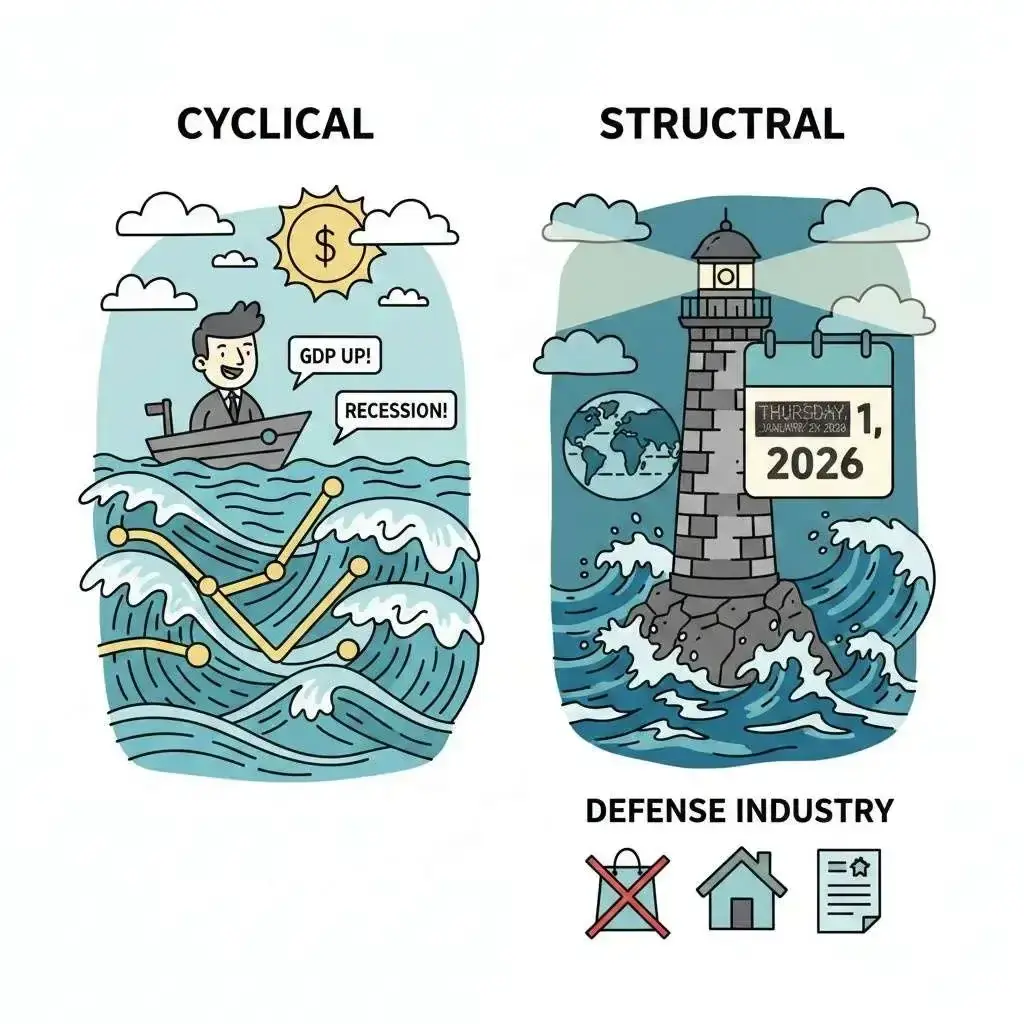
Krishna Defence and the Quiet Side of Defence Compounding
To understand how defence value is created far away from headlines, it helps to look at a company like Krishna Defence.When investors think about defence, they usually picture fighter jets, submarines, or missile systems. Yes, missiles, submarines etc. are the faces of the defence industry and definitely the most important needs to protect the integrity of one’s land, in today’s world. What rarely gets attention is what comes before any of that can exist. Defence platforms are built on materials long before they look like weapons. Steel sections, armour-grade components, welding consumables, underwater fittings these are the first link in the chain. If these inputs aren’t available domestically, even the most ambitious indigenisation plans stay dependent on imports.
Krishna Defence operates precisely at this foundational level.
The company does not manufacture ships, submarines, or armoured vehicles. Instead, it supplies the materials that go into building them. Bulb bars used in naval hulls, welding wires and consumables required for defence-grade fabrication, steel sections for armoured vehicles, ballast bricks, and underwater components, all critical inputs, none of them visible to the end user. Every shipyard and armoured vehicle programme needs these materials, regardless of who assembles the final platform.
This positioning matters more than it appears.
Krishna is already an approved vendor to the Indian Navy and Indian Army and supplies to shipyards such as Mazagon Dock, Cochin Shipyard, and GRSE. In defence manufacturing, approvals are the real moat. Once a supplier is qualified, certified, and embedded into programmes, replacement is rare. The risk of disruption is too high, timelines are too long, and requalification is costly. As a result, approved suppliers tend to see repeat orders across multiple platforms over many years.
What makes material suppliers like Krishna interesting from an investor’s perspective is how quietly they scale. Order books don’t look dramatic. Revenue growth isn’t linear. Execution is lumpy. There are no sharp spikes — just slow accumulation.
Risks remain. Working capital can stretch due to milestone-based payments. Customer concentration is high. Execution complexity increases as products become more advanced. The company has faced delivery delays and liquidated damages in the past, which management has acknowledged openly. These are not red flags unique to Krishna — they are part of operating deep inside long-cycle defence supply chains.
The takeaway isn’t that Krishna Defence is a “fast-growing defence stock.” It's how defence compounding actually looks in practice. Progress is slow, visibility improves gradually, and value is created far away from quarterly excitement. Businesses like this rarely look exciting early. They become obvious only much later, after years of quiet execution.
PSU vs Private Defence Companies: Clearing the Confusion.
1) Why PSUs Dominate Order Books: The Structural Advantage.
PSUs have numerous advantages over Private Defence companies.The Security "Security Blanket"
- The "Un-killable" Partner: A private firm can go bankrupt, get bought out by a foreign entity, or pivot to making electric cars if the money is better. A PSU like HAL isn't going anywhere. That continuity is the ultimate insurance policy for a Ministry of Defence.
- Sovereign Trust: There’s an unspoken "national security bias" here. If a state-owned entity has the blueprints, the government sleeps better at night. It’s that simple.
The Monopoly by Default
- The Infrastructure Gap: PSUs own the massive dry docks, the specialized airfields, and the high-tech testing ranges. For a private company to build these from scratch, they’d need a blank check and three decades.
- The Infinite Safety Net: PSUs aren't sweating their next paycheck. With guaranteed government funding, they can mess up a prototype, go over budget, or take ten years on R&D without the fear of the lights being turned off.
Breaking Down the Divide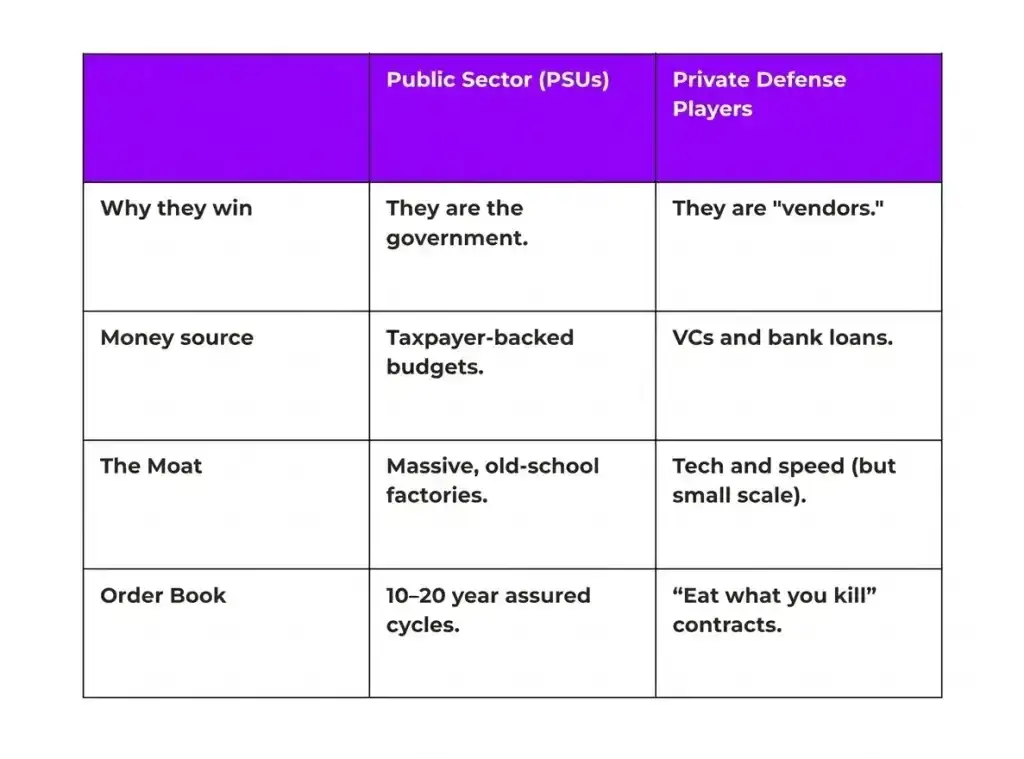
2) Strengths and weaknesses of PSUs.
Strengths
Scale & Near-Monopoly: Most PSUs were built over decades with government money and access. In many sectors, it’s just not practical for a new player to come in and compete at the same level.
Government Support: These companies are important to the system. When pressure builds, policy help or funding usually shows up, which lowers the risk of things going badly wrong.
Weaknesses
Lower Capital Efficiency: Making profits is not always the top priority. Bigger teams, old costs, and extra responsibilities pull returns down.
Bureaucratic Delays: Decisions take time. Too many approvals, too many checks, and not much room to move fast.
3) Why Private Defence Players Matter, and Why Markets Are Watching Them.
Innovation & Niche Focus: Private defence companies are picking their battles. Instead of trying to do everything, they’re focusing on smaller, tech-heavy areas like drones, sensors, electronics, and avionics where growth is faster, and exports are possible.
Across the world, most new defence tech comes from smaller, flexible firms. In India, private players are slowly starting to play that role.
Market Growth & Policy Push: Private companies still make up a smaller part of defence production, but they’re growing much faster. Fresh capital, policy support, and more room under procurement rules have helped revenues scale quickly.
Markets tend to reward this early. Higher growth expectations mean these stocks often trade at a premium, even if current numbers look small.
Competitive Execution: Private firms usually move quicker. Fewer approvals, clearer accountability, and tighter timelines help when bidding for specialised or export orders.
This is why many private defence names fall into the mid-cap sweet spot offering faster growth than giants, but with far more scalability than early-stage firms. Read more in the following article:
Why Mid Cap Stocks are the Sweet Spot for Long-Term Investors.
4) Private Sector Weaknesses and Why They Still Lag
They’re still playing on a smaller fieldPrivate defence companies are growing fast, no doubt. But when you zoom out, most of the really large defence orders still sit with PSUs. Fighter jets, submarines, large warships aren't just products, they’re decades-long programmes. And the government continues to trust those almost entirely to state-owned players.
That has consequences. Smaller order books mean private companies don’t get the same scale benefits. Costs stay higher, bargaining power stays limited, and it’s hard to build capabilities across the full defence stack. Many private firms end up being excellent specialists but specialists nonetheless.
Money is more expensive for them
For private companies, growth has to be paid for. New plants, new machinery, long development cycles, all of it needs capital. And that capital usually comes from shareholders or lenders.
In defence, cash often goes out years before it comes back in. So any delay, any cost overrun, or any policy change hurts more. Margins feel the pressure early. PSUs, on the other hand, get easier financing, mobilisation advances, and the comfort of government backing. Private players don’t get that cushion, they have to earn every inch.
Big possibilities, slow rewards
The upside with private defence firms is flexibility. They can chase exports, move into drones, electronics, space, and dual-use tech. They can try things PSUs won’t or can’t.
But that freedom comes with a price. Research takes time. Certification takes longer. Some bets don’t work at all. In the meantime, margins stay tight and profits look uneven.
So investing in private defence isn’t about quick wins. It’s about believing that patience, execution, and time will eventually pay off.
Order Book Is Not Enough: What Actually Makes a Defence Stock Investable.
In defence investing, order book size grabs attention but order book quality creates returns. Many stocks look attractive on paper because of massive backlogs, yet fail to convert that promise into cash flows, margins, or shareholder value. This section focuses on what actually matters.1) Order Book Quality (Not Just Size)
A ₹50,000 crore order book sounds impressive but investors must ask what kind of orders these are.Firm contracts vs MoUs/LOIs
A Memorandum of Understanding (MoU) or Letter of Intent (LOI) shows intent but isn’t legally binding. Firms often announce these to boost visibility or signal pipeline growth. Only firm contracts guarantee revenue, so it’s critical to separate headline numbers from enforceable orders.
Clearly defined delivery schedules
A large order without a timeline is almost meaningless. Delivery schedules show when revenue will hit, and whether the company can realistically manage production and resources. Stretchy or undefined timelines increase execution risk even big orders may turn into cash-flow headaches if delayed.
Fixed prices vs renegotiable prices
Orders with fixed prices give revenue visibility and help forecast margins. If prices can be renegotiated mid-way due to cost overruns, material price changes, or other clauses the headline order book can overstate the value actually realized.

2) Operating Margin Consistency (Not One-Year Spikes)
When you look at a defence company, a single year with high margins can be tempting, but that number alone can be misleading. Margins can temporarily spike because of things like:One-time deliveries: A company might have completed a particularly large order or delivered a high-value platform in that year.
Favorable project mix: Some projects are naturally more profitable for example, smaller components or exports with higher pricing flexibility. If a company happens to deliver mostly these in one year, margins will look inflated, but it doesn’t mean the whole business is consistently profitable.
Accounting recognition timing: How and when revenue is recognized can also distort margins. A big contract might be partially recognized in one year and mostly in the next, making the current-year margins look better than the underlying operational performance.
What really matters is durability:
Strong businesses show:- Operating margins that are stable across different years and cycles
- The ability to protect margins even during production ramp-ups or when new programmes start.
Weak businesses show:
- Volatile margins from year to year
- Sudden peaks followed by sharp drops
Investor insight: Consistency in operating margins is a far better indicator of a company’s health than occasional peak numbers. Stable margins reflect repricing power, cost control, and operational discipline qualities.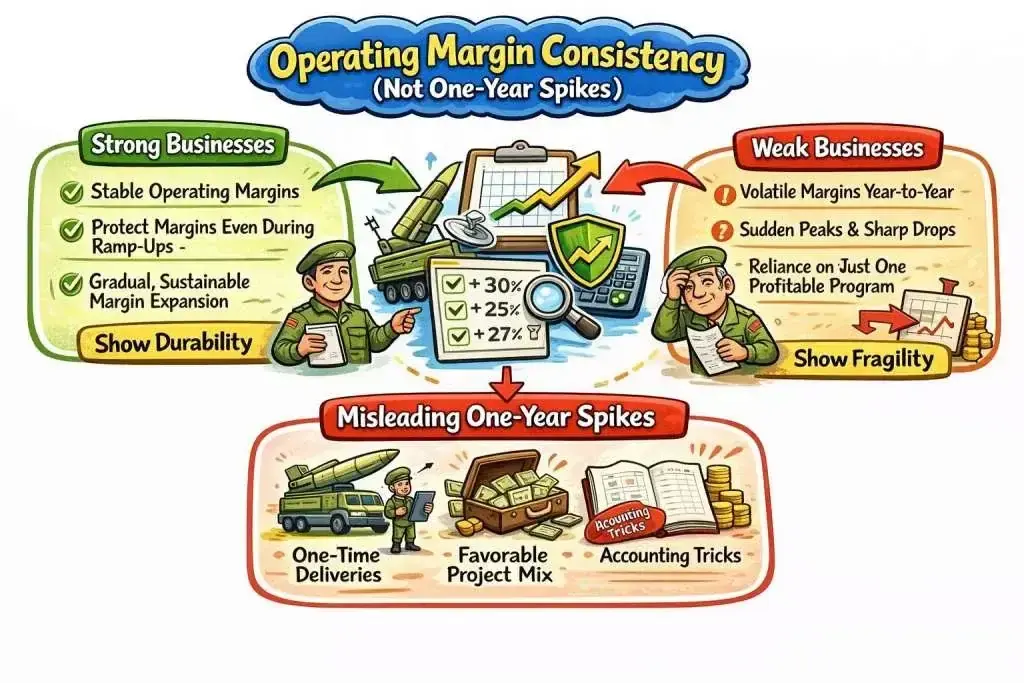
3) Dependency on Single Platforms or Clients
One-program risk: A lot of defence companies quietly depend on one large project to carry their numbers. On paper it looks fine, but underneath, everything is riding on that single programme going smoothly.Risks of high dependency:
- Delays or cancellations: Defence projects are slow, political, and constantly changing. One delay, a redesign, or a pause in approvals can knock earnings off course for years.
- Limited bargaining power: When one customer accounts for most of the revenue, the company doesn’t get to dictate price or terms — it takes what it’s given.
- Valuation vulnerability: The stock ends up moving with that one contract. If sentiment around it changes, the valuation cracks quickly.
What diversification looks like:
- Multiple platforms or subsystems: When revenue comes from several products, a problem in one doesn’t sink the whole business.
Development + production mix: Development keeps the future pipeline alive, while production pays the bills today.
- Domestic + export exposure: Exports act as a cushion when local orders slow or policies shift.
Cross-domain presence: Work across land, air, naval, or electronics spreads risk instead of concentrating it.
Investor insight:
In defence, where projects run for decades, spreading best matters. Platform diversity reduces the chance that one bad outcome derails the entire story.

If you want a quick but disciplined way to apply these checks beyond defence and across any sector, this one-hour fundamental checklist helps filter out weak businesses early: A fundamental checklist: How to research a stock in 1 hour
How to Build a Defence-Focused Portfolio (Step-by-Step)
If you’re thinking of building a defence-focused portfolio, the first thing to accept is that this sector does not behave like most others. Defence companies don’t grow smoothly quarter after quarter, and stock prices don’t respond immediately to good news. Orders take years to turn into revenue, payments are staggered, and execution delays are common. If you approach defence with a short-term or trading mindset, frustration is almost guaranteed. This is a sector that rewards patience more than timing.
- Any defence portfolio should start with a few strong core holdings. These are companies that already have scale, long-standing relationships with the government, and a proven ability to execute large, complex projects. These businesses form the foundation of the portfolio and are meant to be held through ups and downs, not traded around based on headlines. Their role is simple: convert orders into cash steadily and protect capital when sentiment turns negative.
- Once the core is in place, satellite positions can be added selectively. These are usually mid-sized or emerging defence companies working in specific niches such as electronics, components, drones, or precision manufacturing. They tend to grow faster, attract more market excitement, and offer higher upside if things go right. These positions should be meaningful enough to matter, but small enough that mistakes don’t damage the entire portfolio.
- Exposure limits matter a lot more in defence than most investors realise. This ties directly into broader portfolio construction principles knowing how many stocks to hold and how much weight to give each one is just as important as stock selection. Portfolio Diversification: How Many Stocks Should You Hold?
Defence companies often depend on a limited number of programs or clients, which means even a single delay can impact earnings for years. Putting too much money into one defence stock, or even into the sector as a whole, can make the portfolio fragile. Sensible investors cap both sector exposure and individual stock weight, even if they strongly believe in the long-term theme. Defence investing is about endurance, not aggression.
The time horizon is where many investors get it wrong. Defence programs usually play out over five to ten years, not five to ten quarters. Stock prices can remain flat for long stretches even when the underlying business is improving. There will be periods where nothing seems to move, followed by sharp reratings when execution finally shows up in numbers. If you’re not mentally prepared for this uneven journey, it’s better to avoid the sector altogether.
It’s also important to say this clearly: defence is not a trading sector. Contract announcements, geopolitical tensions, or policy headlines can push prices up quickly, but those moves often fade just as fast. Buying after excitement and selling after silence is how most retail investors lose money here. The real gains come from staying invested while the company quietly delivers, quarter after quarter, even when the market isn’t paying attention.
A good defence portfolio is built slowly. It starts with reliable companies, adds selective exposure to higher-growth ideas, respects risk limits, and gives time for execution to play out. There is nothing flashy about this approach, but it works. Defence rewards investors who think like owners, not traders and those willing to wait usually end up being the ones who benefit the most.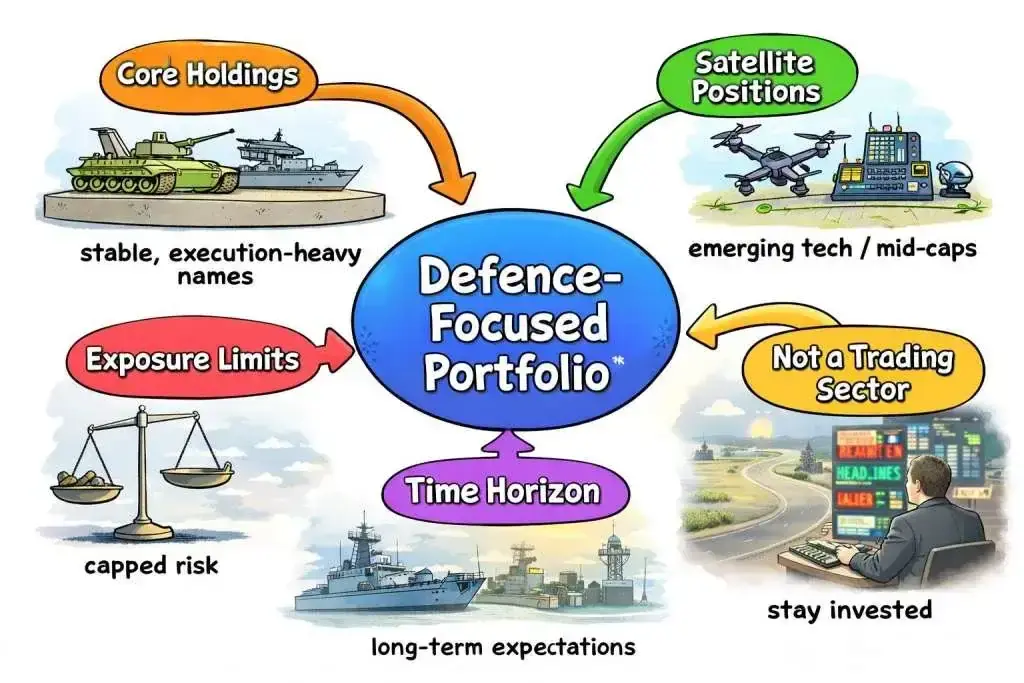
Defence Investing Through the 2047 Lens
When people talk about defence investing, they usually tie it to the next event. A budget. A contract. A geopolitical scare. That’s a very short way to look at a very long story. Defence capability isn’t built in bursts. It’s built slowly, over decades, through trial, failure, and repetition. Vision 2047 isn’t a target date where everything suddenly clicks into place. It’s just a marker on a road that’s already being walked, step by step.This is a multi-decade story because national security doesn’t reset every few years. Equipment ages. Threats evolve. Technology keeps moving forward. Once a country decides it wants control over its defence supply chain, there’s no going back to imports as a default option.
Compounding in defence doesn’t look dramatic while it’s happening. This slow, uneven progress is exactly how long-term wealth is built; compounding rarely looks exciting in real time.
The Power of Compound Interest: How to Create Wealth in the Stock Market.
There are no sudden spikes that neatly explain the story. What happens instead is quieter. Orders keep coming back. Manufacturing improves. Teams get better at execution. Costs come down slowly. Margins don’t explode, they inch up. Exports start small, then repeat. Year after year, these small improvements stack on top of each other. When policy support and real demand move in the same direction for long enough, the results only become obvious much later.
This is where most investors get impatient. They want proof quickly. They want to know if they’re “right”. Defence doesn’t give that reassurance on a quarterly basis. Stocks can stay flat for years even while the business underneath is getting stronger.
What matters more than getting in early is getting in right. Buying the wrong company just because it fits a big national story is an easy mistake to make. Weak execution, stretched balance sheets, or dependence on a single program don’t magically fix themselves over time. In fact, long cycles usually expose these weaknesses even more. Discipline at the beginning choosing companies that can survive delays, learn from mistakes, and keep delivering matters far more than being first.
Over a twenty-year lens, small differences in behaviour turn into large differences in outcome. One company reinvests carefully, manages cash, and builds capability step by step. Another cuts corners, overpromises, and struggles when timelines slip. Early on, they may look similar. Later, they don’t. One becomes an institution. The other fades quietly.
Looking at defence through 2047 isn’t about predicting which stock will do well next year. It’s about asking which businesses are likely to still matter when the country’s defence ecosystem is far more mature than it is today.

Conclusion: Defence Investing Is a Test of Temperament, Not Just Analysis.
Defence investing isn’t about spotting the next contract or reacting to the next headline. It’s about understanding how power, policy, and patience intersect over very long periods of time. This sector moves slowly by design. Decisions are cautious, timelines stretch, and outcomes reveal themselves years after the initial intent. For investors, that means the usual shortcuts don’t work. Order books must be questioned, margins must be tested across cycles, and balance sheets must be strong enough to survive delays without drama.The real divide in defence isn’t between PSUs and private players, but between companies that can endure long cycles and those that cannot. PSUs offer stability and scale, while private firms offer growth and innovation, but both succeed or fail on execution, capital discipline, and the ability to keep delivering when conditions aren’t ideal. Big national narratives don’t protect weak businesses. Long timelines expose them.
A well-built defence portfolio reflects this reality. It is conservative at the core, selective at the edges, and disciplined about risk. Through the 2047 lens, defence investing becomes less about prediction and more about alignment. When national necessity, policy direction, and capable businesses stay aligned for long enough, compounding follows almost as a byproduct. The edge doesn’t come from speed or excitement. It comes from staying power. And in defence, staying power is everything.
Comment “INVEST IN DEFENCE” if you want a deep-dive on identifying high-quality defence businesses before the numbers look exciting.
Explore our Products
Research Framework

Emerging Titans
Combination of quantitative analysis, industry tailwinds, and management assessment - SPRINT investment philosophy

Tiny Titans
Heavy emphasis on scuttlebutt research, plant visits, and early on-ground signals
FAQs
What are the best Defence stocks to buy?
+India’s defence landscape is led by public sector giants such as Hindustan Aeronautics (HAL), Bharat Electronics (BEL), Bharat Dynamics (BDL), and Mazagon Dock Shipbuilders (MDL). Alongside them, a growing group of private players including Data Patterns, Paras Defence, and Zen Technologies is gaining traction, supported by government policy and rising technological capabilities.
How Can I Invest in the Defence Sector?
+Single stock names grab the headlines but there are ways to gain diversified exposure to the defence spending theme via a range of funds including Defence ETFs, Futures and Mutual funds.
Is Defence investing long term or short term?
+Defence investing is very much a long-term game. Nothing meaningful happens quickly in this sector. Orders don’t turn into revenue overnight, payments come in stages, and projects move at their own pace. Prices may jump on headlines or news flow, but those moves rarely last. The real returns come quietly, over years, as companies keep delivering, learning from mistakes, and slowly improving margins. If you’re looking for fast results, defence can be frustrating. If you’re willing to stay patient for five to ten years, that’s where the value actually shows up.
What financial metrics matter most in defence investing?
+Beyond revenue growth, investors should track operating margin consistency, working-capital cycles, cash-flow conversion, and balance-sheet strength. Companies that manage capital well during long project cycles tend to outperform over time.

High growth stock specialist, Value Educator
Shashank Mahajan is an equity research professional with over 12 years of experience in identifying high-potential SME and micro-cap stocks at an early stage. He follows a rigorous scuttlebutt research–driven approach, combining on-ground insights with deep financial analysis. Shashank specializes in uncovering under-researched and under-owned companies with strong management quality and long-term growth potential. Through disciplined research and early identification, he focuses on spotting tomorrow’s market leaders before they enter the mainstream investor radar.

Zen Technologies: Why Revenue Fell After Its Biggest Win

Data Patterns: India's Radar Designer and Its Waiting Orders

KSH International: The Wire Inside India's Transformers

Krishna Defence: The Steel Behind India's Warship Hulls

PNG Jewellers: A 194-Year-Old Name Goes National

Axiscades: From Services to Missile and Radar Electronics
Explore our Products
Research Framework
Emerging Titans
Combination of quantitative analysis, industry tailwinds, and management assessment - SPRINT investment philosophy
Tiny Titans
Heavy emphasis on scuttlebutt research, plant visits, and early on-ground signals


 Orders
 Subscription
 Share with friends
 Logout


Required Details
₹23999.00
(12 month subscription)
As per SEBI regulations, all users are mandated to complete the KYC that is validated for 1 year. Post payment, you will be redirected to the KYC screen


No comments yet. Be the first to comment!