
Monsoon and the Indian Stock Market

What if it doesn’t rain enough this year?
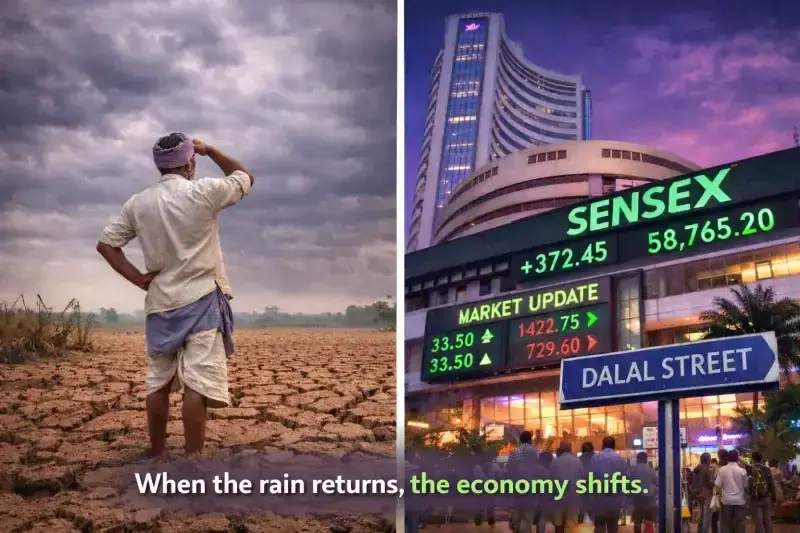
The consequences won’t announce themselves through a market crash or a flashing headline. They start much earlier ,in villages postponing purchases, in food prices that refuse to cool, and in policymakers forced to stay cautious longer than expected.
While the consequences of a poor monsoon are usually felt only on the agricultural sector, they are far more insidious since they change the mindset of households, restrain consumption, erode corporate profitability, and jeopardize inflation control efforts. These are felt silently before they leave any imprint on the stock market.
By the time markets react, the damage ,or adjustment ,has already taken place.
This is why understanding the monsoon isn’t about predicting rainfall. It’s about understanding how weather feeds into consumption patterns, sector performance, and investor sentiment ,especially in an economy where a large share of demand still depends on rural income.
This article breaks down how that chain actually works, where the pressure points emerge first, and why the stock market often reacts only after the real economic story has already unfolded.
Why Agriculture Still Shapes India’s Economic Stability
India’s growth story today is often told through services, startups, and digital expansion. But agriculture continues to sit at the base of the economy, simply because of how many people it still touches.
“Agriculture is the backbone of the Indian economy, not because of its share in GDP, but because of the number of lives it sustains.” - M.S. Swaminathan
For most of the country, agriculture is not a category on a balance sheet; it is a source of employment. About 65% of the Indian population has some kind of association with agriculture and related activities, and about 55% of the workforce is employed in this area. Figures like these reveal one thing: agriculture is a scale that very few industries can match.
If you consider only the output, agriculture might not be as significant as the industry or services sector. Agriculture, forestry, and fishing contributed 14.4% of the Gross Value Added at constant prices and about 18% at current prices in 2024-25. This is lower than the services sector, but it is not to be underestimated either. Even a small fluctuation in agricultural performance can be reflected in economic performance.
What adds to the sensitivity of the sector is that it is monsoon-dependent. A significant portion of India’s agricultural land is still rain-fed, which means that agricultural performance is directly linked to how the monsoons are. When they are favorable, it works in favor of the sector. When they are not, the effects are immediate.
Taking all these factors together, the employment footprint of agriculture, its contribution to GDP, and its monsoon dependence are the reasons why the sector remains relevant despite the fact that its contribution to GDP is gradually reducing.
From Monsoon to Markets: The Economic Transmission
The stock market does not react to rainfall data on its own. What matters is how the monsoon alters economic conditions over time.
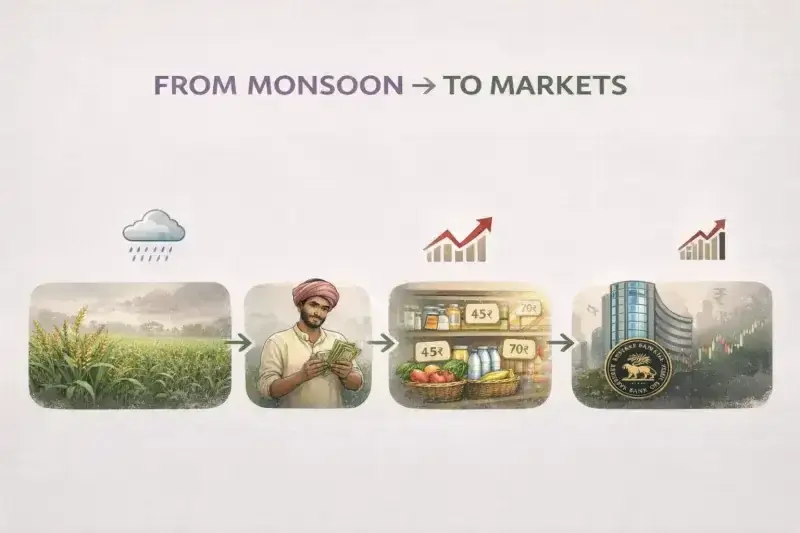
It starts with crop output. A good monsoon usually means healthier crops and fewer supply worries. But when rainfall is patchy or delayed, production quickly comes under pressure, and the sense of uncertainty sets in early.
Changes in output naturally affect incomes in rural areas. That part of the story is already well understood: higher farm incomes support spending, while weaker outcomes lead households to hold back. Markets don’t track this daily, but they feel its effects over time.
Where the impact becomes more visible is through food prices. Strong crop output helps keep prices stable, while weak production can push them higher. Given the weight of food items in India’s consumption basket, these price movements matter far beyond the farm sector.
Food prices directly contribute to inflation patterns. If food inflation remains high, it becomes difficult to manage overall inflation. If it moderates, it becomes easier.
Inflation data is a key driver of monetary policies. If inflation is under control, the Reserve Bank of India gets more latitude to promote growth. If inflation is sticky, policies remain tight for a longer period.
“In India, inflation often begins in the kitchen before it appears in macroeconomic data.” - Raghuram Rajan
Read More: 10 Stock Market Terms Every Beginner Must Know Before Investing
Interest rates are the final agents of change. They affect rates of borrowing, business expansion plans, and investors’ attitudes towards future earnings. Rate-sensitive sectors are the first to be impacted, but attitudes soon permeate the entire market.
This is how the monsoon affects Dalal Street – not through rainfall data, but through a series of events in the world of output, prices, policies, and expectations. The stock market reacts to the economic impact of the monsoon, not the monsoon itself.
What the Data Really Shows
“The most dangerous thing in investing is believing that what happened recently will continue.” Howard MarksThe stock market digests economic news via the lens of market expectations, as opposed to market outcomes. The prospects, pressures, and policies affecting economic growth, as well as inflation, are reflected in factor inputs.
Read More: How to Read a Balance Sheet Like a Professional Investor
As investors re-evaluate future cash flows and cost of capital, prices change – often long before any economic effects appear in data. This is why market movements linked to the monsoon tend to be indirect, uneven, and spread over time.
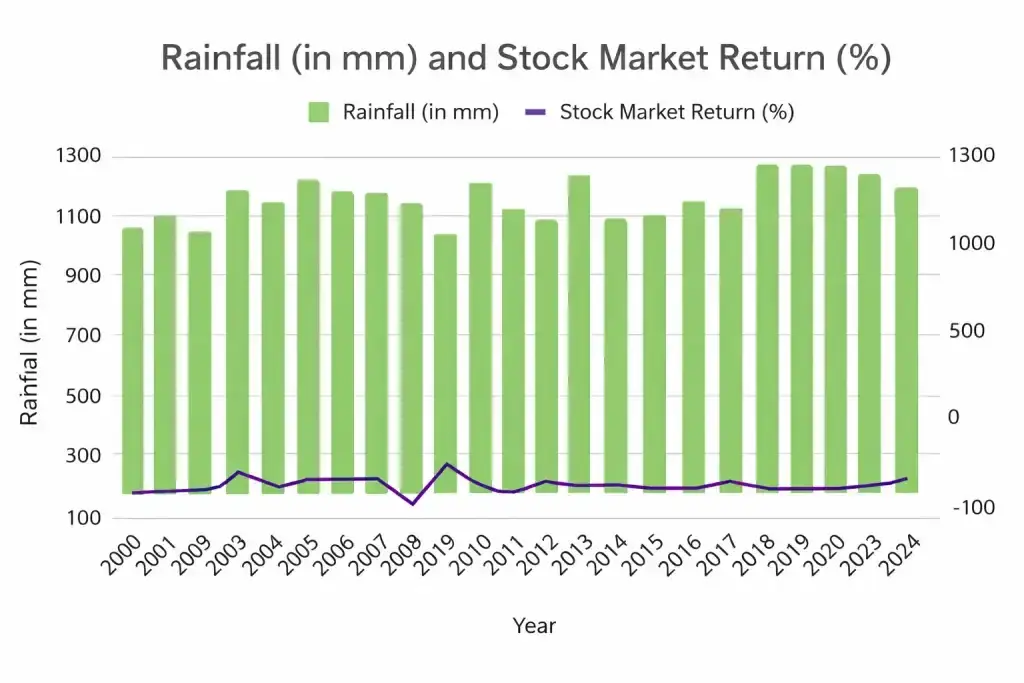
A visual comparison between rainfall deviation and Sensex, as well as total stock market return,s does not reveal a consistent trend. Years of high rainfall do not correspond to years with superior stock market returns; likewise, years that experience low rainfall do not correspond with years that have positive stock returns.
"In a few cases, it appears as though the rainfall patterns and the markets have an alignment, but this is the exception, not the rule."
The most notable observation from the graph is that the relationship does indeed exist, even though the effect is not immediate and not linear. Rainfall impacts the economy through its effect on agricultural output, rural income, food prices, and inflation, and such effects take time to manifest, not immediate ones. As a result, investor expectations formed during the monsoon season often diverge from actual market outcomes.
Additionally, over many years, market results may be influenced by events far bigger or farther-reaching than domestic rainfall. In many cases, global economic cycles, financial crises, and events caused by policy changes can overwhelm equity markets, minimizing the effects of the monsoon rains.
If the impact isn’t direct, which parts of the market feel it most?
Which Sectors Feel the Impact, and Why?
The monsoon doesn't immediately affect the stock markets. The impact of the monsoon takes time to unfold, beginning with agriculture-related sectors, then moving on to income, demand, and expectations.“Not everything that matters is obvious, and not everything obvious matters.” - Morgan Housel

The first stock market reaction is often seen in the agriculture sector and the agri-input space. If the monsoon forecast is normal or favourable, demand for seeds, fertilizers, and agri-chemicals increases. This would positively impact companies such as Kaveri Seed Company, Dhanuka Agritech Limited, Coromandel International Limited, Chambal Fertilisers & Chemicals Limited, UPL Limited, and PI Industries Limited. If the monsoon forecast is unfavourable, these companies would see underperformance.
Moving forward, as the season progresses, the spillover will be seen in farm machinery and equipment as well, as better rains will boost farm cash flows and induce spending on tractors and other machinery, benefiting companies like Mahindra & Mahindra and Escorts Kubota. In bad monsoons, this would be spent and purchased over time, which would reflect as a delayed demand scenario.
The next phase can be seen in the rural consumption curve. Stable rainfall will boost farm incomes, in turn fueling demand for essential as well as non-essential goods over time for FMCG companies with significant exposure in the rural market, such as Hindustan Unilever, ITC, Dabur, and Britannia.
Two-wheeler manufacturers like Hero Moto, TVS Motor, and Bajaj Auto also stand to gain. Weak monsoons cause households to cut back on spending. For every weak monsoon that hits the country, households cut back on spending; it does not result in the complete stopping of expenditure.
Certain agri-related manufacturing industries also experience the impact through raw materials. Better rainfall is favorable for crops like cotton and sugarcane, which can boost companies like Arvind and Vardhman Textiles, as well as companies like Balrampur Chini, Dhampur Sugar, and Dalmia Bharat Sugar.
This feed-through effect then spills over into the financial intermediaries with rural sector exposure. A healthy income level in rural areas will support credit growth as well as repayment ability for lenders like banks – SBI, Bank of Baroda, Indian Bank, Bandhan Bank, Credit Access Grameen, etc. – as rainfall hurts growth later if rainfall is poor.
Lastly, the monsoon would affect interest-rate-sensitive markets indirectly through inflation. Poor rainfall would mean a rise in food inflation, which would limit the scope for the RBI to lower interest rates. Several sectors would be impacted, including interest-rate-sensitive stocks like real estate, automobiles, and capital goods, DLF, Maruti Suzuki, Larsen & Toubro, and Siemens India.
Read More: What is Market Capitalization? Large, Mid, Small Cap Explained with Examples
Key takeaway:
A monsoon is not a market-wide trigger but rather a sectoral filter. The effect is gradual rather than sudden and works through activity, income, inflation, and policy responses rather than an immediate response via the stock market.
Tracing the Monsoon’s Impact Through FMCG Stocks
If the monsoon directly dictated stock market performance, the data would look far cleaner than it does. Two contrasting years,2002 and 2020, make this clear, especially when viewed through the lens of FMCG, a sector closely tied to rural demand.In 2002, India experienced one of its worst monsoon failures, with rainfall nearly 21% below normal. Agricultural output was hit, rural incomes weakened, and consumption slowed. This stress showed up clearly in FMCG stocks. NIFTY FMCG index declined by approximately 12.6% during this year. With the fall in farm incomes, the demand for consumption items began to fall, hence affecting the performance in the market.
Read More: Circulation vs. Consumption Stocks: Which Type is More Recession-Proof?
Now let's compare it with the year 2020. The rainfall in 2020 was also 10% more than the average rainfall. Therefore, FMCG companies got their tailwinds as their demand level was stable and the NIFTY FMCG index rose by almost 13.5%. The above appears to be an obvious cause-and-effect relationship.
Yet if one focuses on the larger view:
Despite the low rainfall received in 2002, the Sensex rose by more than 80% due to growth driven by global liquidity, post-dotscom, and improvement in macro sentiment. In 2020, even though rainfall was high, the market movements remained subdued compared to the Sensex.
The takeaway isn’t that rainfall doesn’t matter ,it clearly does for sectors like FMCG. . The moral of the story here is that monsoon rains impact sectoral markets, which are in turn impacted by macro variables. While rains impact individual incomes, thereby affecting FMCG companies' earnings, the share market's returns are subject to other factors as well.
This is why the rainfall- market relationships seem so inconsistent. The monsoon works through the economy first, not directly through stock prices.
Is the Monsoon Still as Powerful as It Once Was?
Cases like 2002 and 2020 indicate that even though the monsoon is relevant, its relevance has varied over the years.
“India’s strength today lies in its ability to absorb shocks without breaking.” - Nandan Nilekani
India’s direct dependence on rainfall has come down significantly. In fact, an increase in irrigation coverage, good management of water, better storage systems, and swift government intervention have taken away a lot of the bite from bad monsoons. The resilience level that is part of modern agriculture is much higher than it was two decades ago.
Reciprocally, the composition of the economy has altered in the sense that the services sector has contributed more to the economy, as has urban consumption to corporate profits. This means agricultural stress no longer translates automatically into market-wide weakness.
That doesn’t make the monsoon irrelevant. It changes how it matters. Instead of acting as a single decisive force, rainfall now influences markets indirectly, through food prices, inflation expectations, policy decisions, and sentiment.
What does this imply:
The monsoon no longer drives markets outright, but it still shapes the conditions under which markets operate.
Explore our Products
Research Framework

Emerging Titans
Combination of quantitative analysis, industry tailwinds, and management assessment - SPRINT investment philosophy

Tiny Titans
Heavy emphasis on scuttlebutt research, plant visits, and early on-ground signals
Conclusion: Reading the Monsoon Without Trading the Clouds
The monsoon does matter in India, though quite differently from what the front page of the newspaper suggests. Rainfall does impact the market; no, that is incorrect. The changing market environment is what impacts the market. And that changes due to rainfall. Of course, that ultimately impacts the market sentiment, which in turn impacts the market.
This explains why the relationship between rainfall and the performance of the stock market does not make much sense. Strong monsoons don’t guarantee strong returns, and weak ones don’t automatically trigger sell-offs. The impact works through multiple layers, with time lags and interruptions from global cycles, policy decisions, and investor sentiment. The monsoon is a backdrop, not a switch.
Read More: Portfolio Rebalancing – Why and When You Should Adjust Your Portfolio
If this article helped you look past rainfall headlines and think more clearly about how macro signals travel to Dalal Street, comment “RAINFALL” below. Like the piece to support data-driven market analysis, share it with someone who tracks markets through news alone, and comment on one macro indicator you’ll pay closer attention to going forward.
FAQs
Does a good monsoon guarantee a rising stock market?
+No. A good monsoon supports agricultural output and rural incomes, but stock market performance depends on a wider set of factors such as global liquidity, earnings growth, interest rates, and investor sentiment. The monsoon influences markets indirectly, not mechanically.
Why don’t markets react immediately to rainfall data?
+Because rainfall affects the economy with a lag. The chain runs from crop output → rural income → consumption → inflation → policy decisions. Markets respond to how these factors evolve over time, not to rainfall numbers themselves.
Which sectors are most sensitive to monsoon outcomes?
+Sectors closely tied to rural income and food prices feel the impact most. These include Agri-input companies, farm machinery, FMCG with rural exposure, rural-focused lenders, and interest-rate-sensitive sectors affected by inflation and policy responses.
If agriculture contributes a smaller share to GDP today, why does the monsoon still matter?
+While agriculture’s GDP share has declined, its employment footprint remains massive. Changes in farm income influence consumption, inflation, and political and policy responses, all of which matter for the broader economy and markets.
How do examples like 2002 and 2020 fit into this analysis?
+They show that rainfall affects sectors, not the entire market uniformly. In 2002, weak rainfall hurt FMCG despite a strong Sensex rally driven by global factors. In 2020, good rainfall supported FMCG, but broader market returns were shaped by pandemic-related forces. The lesson: sectoral impact ≠ market outcome.

High growth stock specialist, Value Educator
Shashank Mahajan is an equity research professional with over 12 years of experience in identifying high-potential SME and micro-cap stocks at an early stage. He follows a rigorous scuttlebutt research–driven approach, combining on-ground insights with deep financial analysis. Shashank specializes in uncovering under-researched and under-owned companies with strong management quality and long-term growth potential. Through disciplined research and early identification, he focuses on spotting tomorrow’s market leaders before they enter the mainstream investor radar.

Zen Technologies: Revenue Fell After a Big Win



PNG Jewellers: A 194-Year-Old Name Goes National
Explore our Products
Research Framework
Emerging Titans
Combination of quantitative analysis, industry tailwinds, and management assessment - SPRINT investment philosophy
Tiny Titans
Heavy emphasis on scuttlebutt research, plant visits, and early on-ground signals


 Orders
 Subscription
 Share with friends


Required Details
₹23999.00
(12 month subscription)
As per SEBI regulations, all users are mandated to complete the KYC that is validated for 1 year. Post payment, you will be redirected to the KYC screen


No comments yet. Be the first to comment!