
Network Effects Explained

When a company reports strong growth, it grabs our attention instantly. Sales are up. Users are rising. Everything seems to signal success. But if we slow down for a moment, a simple question appears. Does becoming bigger automatically mean becoming stronger?
Some businesses grow because they pour money into advertising or offer prices that are too attractive to ignore. For a while, it works. Customers come in. Numbers look great. But if the spending slows, does the growth still stand on its own?
Now imagine a different kind of business. One where every new customer actually makes the experience better for the next customer. Where growth does not just increase revenue, but improves the product itself. That feels very different.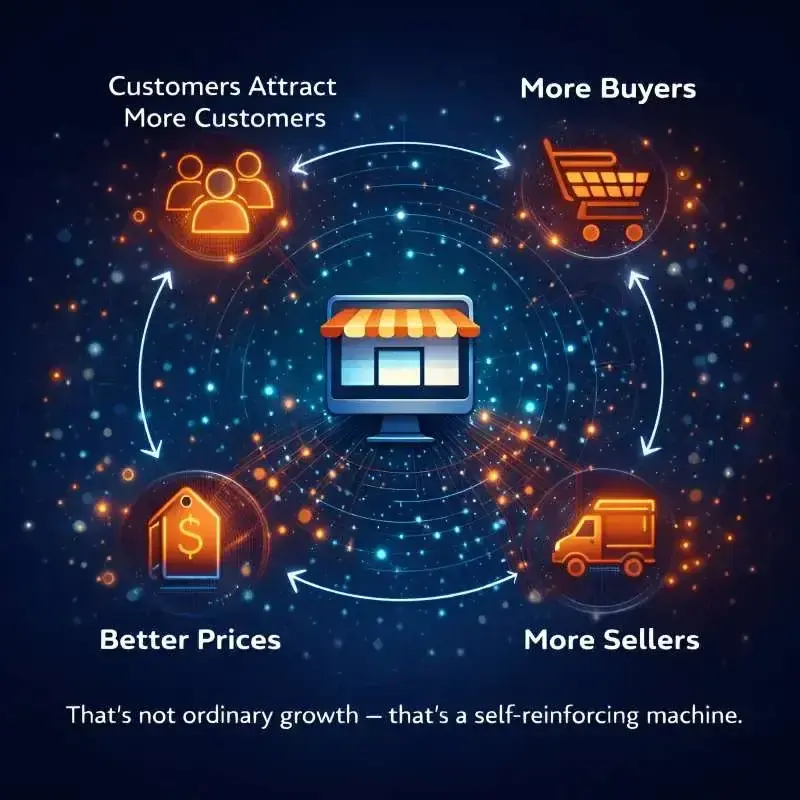
In these models, scale changes the game. More users create more connections. More activity creates more value. Over time, the system becomes harder to leave and even harder to compete with.
As Warren Buffett has often reminded investors, what truly matters is the durability of a competitive advantage. Real strength is not about how fast you grow, but about whether growth makes you tougher to challenge.
If you are looking for a structured framework to find multibagger stocks, then read our article on: The Multibagger Framework: A Step-by-Step Guide to Finding 10x Stocks.
This is where network effects quietly step in. Not as a trendy phrase, but as the hidden reason some businesses keep getting stronger, simply because more people choose to use them.
The Architecture of an Unbeatable Business Model
Most people think a business model is just how a company makes money. It feels simple. Sell something. Earn revenue. Repeat. But if we pause for a second, a deeper question comes up. Is making money the same thing as building strength?At its core, a business model answers three things: Who creates value. Who captures value & how that value grows over time.
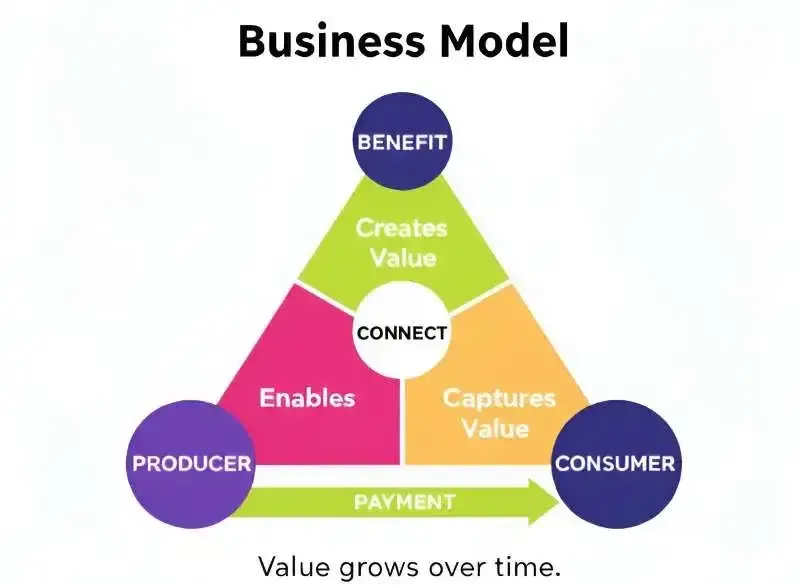
In many traditional businesses, the flow is straightforward. The company produces. The customer consumes. Money moves in one direction.
That model can scale. But it does not necessarily transform. More customers usually mean more sales. Yet the product itself stays largely the same. Growth stretches the system. It does not reinforce it.
Now consider a different architecture. One where each new user does not just buy something, but improves the system for everyone else. The value does not travel in a straight line. It circulates. Participation itself becomes an input.
In these models, customers are not endpoints. They are part of the infrastructure. Think of Visa. Every additional merchant or cardholder makes the network more useful for everyone already inside it.

This is what separates features from structure. Features can attract attention. Structure determines durability. In a linear model, scale adds volume. In a network model, scale adds strength. And over time, that architectural difference is what makes a business not just bigger, but harder to compete with.
The S.C.A.L.E.R Test (Your Proprietary Filter)
Most investors look at growth and feel reassured. Revenue is rising, users are increasing, and margins look stable. But growth alone doesn’t tell you whether a business is becoming more defensible. The real question is whether each new participant strengthens the system for everyone already inside it.In a true network business, scale should reinforce the core. Friction declines, connections multiply, and competition becomes less threatening over time. As Warren Buffett says, “The most important thing is trying to find businesses with wide and long-lasting moats.” The S.C.A.L.E.R Test helps you determine whether that moat is actually deepening as the company grows.
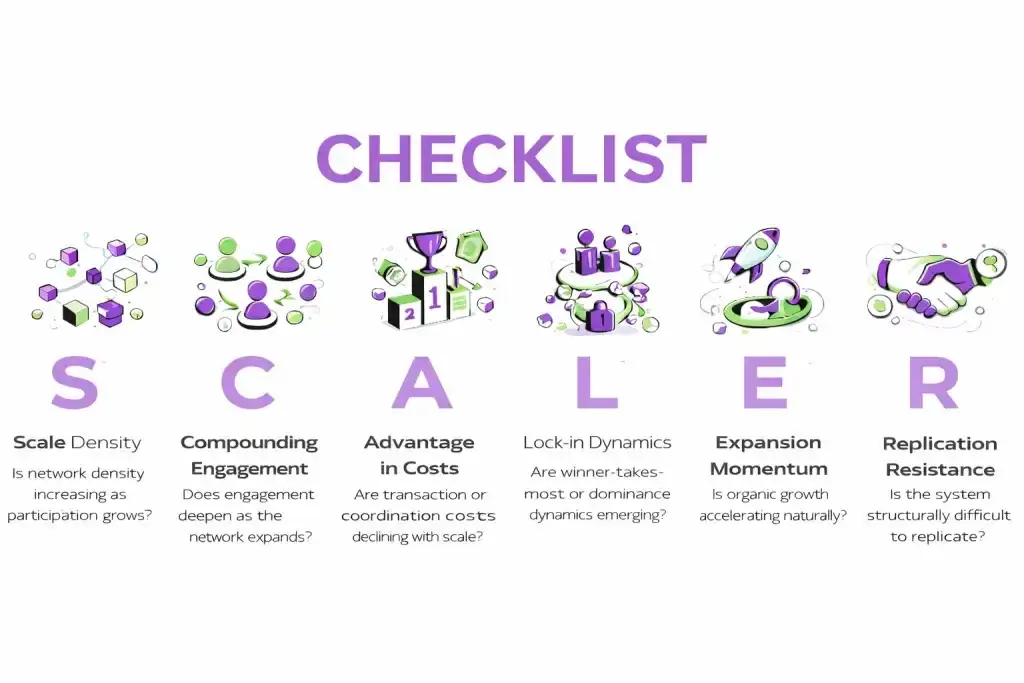
S — Scale Density
Is the network simply adding more users, or is it becoming more connected with every new participant? When someone joins, do they meaningfully interact with others, or just sit idly on the edge? Does scale increase the number of valuable connections inside the system, or only inflate the headline numbers?Scale Density is not about how many people are present; it is about how tightly they are connected. In a strong network, each new participant increases the possible interactions for everyone else. The web becomes richer, faster, and more useful as it expands.
This is why density matters more than raw growth. A platform can double its users and still remain fragile if those users rarely interact. But when interaction per user rises alongside participation, the structure begins to reinforce itself.
Dense networks improve outcomes naturally. Matches happen faster, liquidity deepens, and the experience becomes smoother because the right counterpart is easier to find. Friction quietly declines as the system grows.
Investors who focus only on user numbers often miss this layer. As Warren Buffett has often pointed out, the real advantage lies in businesses whose strength compounds over time. Density is one of the earliest indicators that such compounding is underway.
Read more about compounding in our article: The Power of Compound Interest: How to Create Wealth in the Stock Market.
When participation increases, and connection intensity rises with it, the network gains resilience. Competitors may copy features, but they cannot easily replicate deep, embedded connections. That is when growth stops being expansion and starts becoming a structural advantage.
C — Compounding Engagement
As the network expands, does engagement simply spread wider, or does it grow deeper? Are users just present, or are they participating more frequently and more meaningfully over time? Does scale increase interaction intensity, or does it dilute attention across a larger base?Compounding Engagement is about depth, not reach. In a strong network, growth should increase activity per user, not reduce it. As more participants join, conversations become richer, transactions more frequent, and usage more habitual.
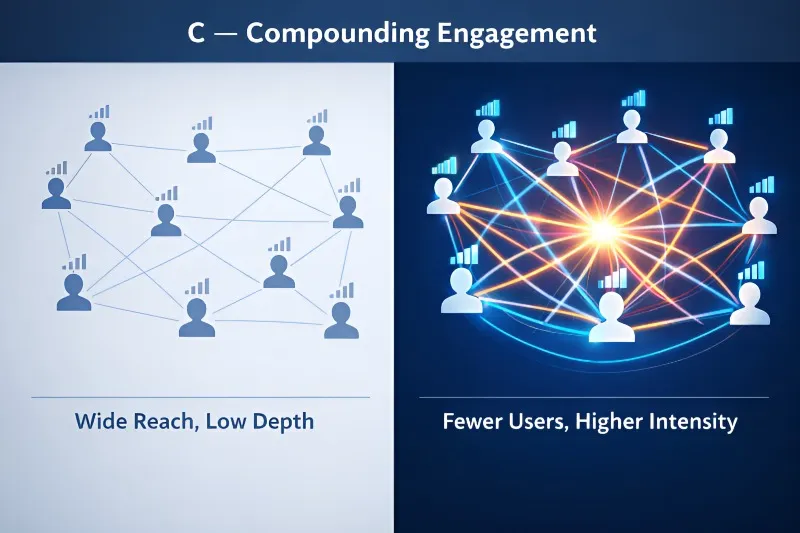
This is where network strength quietly accelerates. More connections create more reasons to return. More participation creates more relevance. The experience becomes increasingly personalized and valuable because the ecosystem itself is more active.
Engagement that compounds signals structural stickiness. Users are not just signing up; they are integrating the network into their routine. The cost of leaving rises because relationships, data, and reputation are embedded in the system.
As Jeff Bezos once noted, “We see our customers as guests to a party.” In a powerful network, the party becomes more engaging as more guests arrive. Energy feeds energy.
If expansion leads to deeper participation per user, the network is strengthening from within. That is not growth driven by marketing — that is growth reinforced by engagement itself.
A — Advantage in Costs
As the network grows, do transaction and coordination costs fall, or do they stay the same? Does adding more participants make it cheaper and easier to connect, match, and execute? Or does scale introduce more friction, complexity, and overhead into the system?Advantage in Costs is one of the clearest signals of a true network effect. In a powerful network, more participants reduce search costs, improve price discovery, and increase matching efficiency. Liquidity improves, delays shrink, and the cost of finding the right counterparty declines naturally with scale.

Lower transaction costs create a reinforcing loop. Easier execution drives more usage. More usage deepens liquidity. Deeper liquidity further reduces friction. Over time, the network becomes the most efficient place to transact.
As Charlie Munger often emphasized, durable businesses build systems that get better with scale, not more expensive. When participation systematically reduces cost and friction, the advantage is no longer operational — it is structural.
If scale is making transactions faster, cheaper, and more seamless, the network is compounding its efficiency. And efficiency, once embedded into architecture, becomes extremely difficult to compete against.
L — Lock in Dynamics
As the network grows, is it becoming the default choice in its category? Are participants naturally gravitating toward one dominant system, or is value still fragmented across competitors? Do users feel an increasing cost to switching, or can they leave without losing anything meaningful?Lock-in dynamics emerge when participation creates dependence. In strong networks, users build reputation, transaction history, relationships, and workflow integration inside the system. Leaving does not just mean choosing another service. It often means giving up embedded trust and accumulated advantage.|
The largest and most active network usually offers the best liquidity, the highest engagement, and the smoothest experience. That combination attracts even more participants, reinforcing its lead over time.
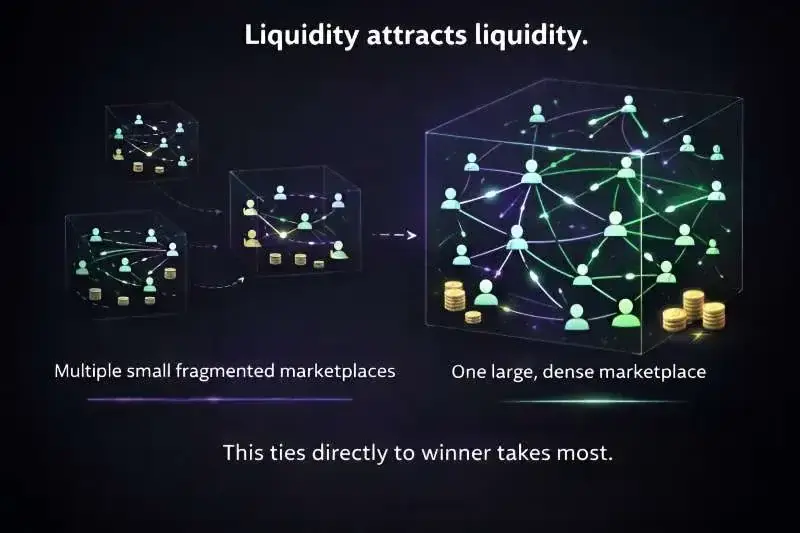
As Peter Thiel has argued, great businesses move away from competition toward monopoly-like characteristics. When participation strengthens dominance naturally, the network begins to tilt the field in its favor.
To identify businesses with network effects that have a strong chance of becoming a multibagger, you need to have an idea about the traits that these businesses have.
To know more, read our article on: 7 Early Signals That a Stock Can Turn Multibagger
If scale is steadily concentrating activity into one ecosystem, lock-in is forming. And once embedded deeply enough, that dominance becomes very difficult to unwind.
E — Expansion Momentum
Is growth being pushed by marketing spend, or is it being pulled by the network itself? Are new participants joining because of incentives and advertising, or because existing users are creating reasons for others to enter? Does the scale require constant external fuel, or is the system beginning to move on its own?Expansion Momentum appears when growth becomes self-propelled. In a true network business, every new participant increases visibility, value, and utility for others. Referrals rise, word of mouth strengthens, and discovery improves without proportional increases in spending.
This is where growth shifts from effort to inevitability. More activity creates more content, more transactions, and more relevance. That relevance attracts more participants, who in turn create more activity. The loop begins reinforcing itself. That is actually the concept and science behind referrals.
Organic acceleration is a powerful signal because it reveals structural demand. The network is not just acquiring users; it is generating reasons for participation internally. The engine starts compounding without requiring heavier external inputs.
As Jeff Bezos has emphasized, enduring businesses build systems that customers naturally advocate for. When growth increasingly comes from inside the ecosystem rather than outside campaigns, momentum is forming.
If expansion strengthens as scale increases, the network is beginning to move under its own force. And when growth becomes self-sustaining, competitive pressure starts to weaken.
R — Replication Resistance
If someone copied the product tomorrow, could they copy the system? Could they recreate the relationships, the trust, the liquidity, the behavior patterns, and the embedded advantages? Or would they only replicate the surface while the core remains untouchable?Replication Resistance exists when value is embedded in structure, not features. The interface can be cloned, but the network cannot. The density of interactions, the historical data, the switching costs, and the economic interdependence create invisible barriers that are extremely hard to rebuild from scratch.

True networks compound history. Every transaction, rating, connection, and feedback loop strengthens the architecture. A competitor may launch with funding, but they start without the accumulated depth that makes the system powerful. Time becomes an advantage.
This is why many network businesses look simple but are strategically complex. What appears easy to copy is often only the outer shell. The internal coordination mechanisms, incentives, and scale-based efficiencies create structural durability.
As Warren Buffett often says, the best businesses have moats that are difficult to cross. Replication Resistance is the network’s moat. It protects scale by making imitation economically irrational.
To enhance your knowledge of the market, you can also refer to our article on: How to Analyze a Mid-Cap Company – Complete Framework
When replication becomes structurally difficult, competition shifts from feature wars to ecosystem wars. And ecosystems, once mature, are far harder to displace than products.
Conclusion & CTA
Many investors talk about network effects, but few pause to test whether they’re actually strengthening. Without a structured lens, growth can look impressive while underlying density, engagement, or cost advantages remain shallow. That’s how narratives take over while structure quietly decides the outcome.The real edge lies in asking better questions. Is scale reinforcing value? Are participants becoming more interdependent? Is growth accelerating organically while replication becomes harder? When you evaluate networks through structure instead of hype, you shift from chasing stories to assessing durability.
If this framework changed how you look at platform businesses, comment “SCALE” below. Like if it sharpened your thinking, share it with someone studying network-driven companies, and tell us which of the six tests you find most powerful.
If you want to quickly analyze a company and determine whether it is a good buy or not, you can read our article on: A fundamental checklist: How to research a stock in 1 hour
Explore our Products
Research Framework

Emerging Titans
Combination of quantitative analysis, industry tailwinds, and management assessment - SPRINT investment philosophy

Tiny Titans
Heavy emphasis on scuttlebutt research, plant visits, and early on-ground signals
FAQs
Does every fast-growing company have strong network effects?
+Not necessarily. Growth can come from marketing spend or temporary demand. True network strength shows up when scale increases value and reduces friction within the system.
Can a company pass one test but fail others?
+Yes. A business might show engagement but lack cost advantages or replication resistance. The strength of a network lies in how many structural reinforcements work together.
Are network effects only relevant for tech companies?
+No. While common in digital platforms, network dynamics can exist in marketplaces, payment systems, financial exchanges, and even certain offline ecosystems.
How do I identify organic expansion momentum?
+Look for rising participation driven by user behavior rather than rising acquisition spend. Referral growth, increasing usage frequency, and accelerating activity are key signals.
Why is replication resistance so important?
+Durable returns come from systems that competitors cannot easily rebuild. If the structure can be copied quickly, the advantage rarely lasts.
Can network effects weaken over time?
+Yes. If engagement drops, switching costs fall, or better alternatives emerge, the reinforcing loops can reverse. Networks require continuous health, not just early momentum.

High growth stock specialist, Value Educator
Shashank Mahajan is an equity research professional with over 12 years of experience in identifying high-potential SME and micro-cap stocks at an early stage. He follows a rigorous scuttlebutt research–driven approach, combining on-ground insights with deep financial analysis. Shashank specializes in uncovering under-researched and under-owned companies with strong management quality and long-term growth potential. Through disciplined research and early identification, he focuses on spotting tomorrow’s market leaders before they enter the mainstream investor radar.

Zen Technologies: Revenue Fell After a Big Win




PNG Jewellers: A 194-Year-Old Name Goes National

Explore our Products
Research Framework
Emerging Titans
Combination of quantitative analysis, industry tailwinds, and management assessment - SPRINT investment philosophy
Tiny Titans
Heavy emphasis on scuttlebutt research, plant visits, and early on-ground signals


 Orders
 Subscription
 Share with friends


Required Details
₹23999.00
(12 month subscription)
As per SEBI regulations, all users are mandated to complete the KYC that is validated for 1 year. Post payment, you will be redirected to the KYC screen


No comments yet. Be the first to comment!