
Why Promoter Buying Is a Strong Signal
Most stock market tips fade away faster than yesterday's news, but one strategy has stood the test of time: when the people running the company start buying shares with their own money, you should pay attention. Research consistently shows that insider activity is the most reliable barometer of where a stock is truly headed. If the directors and executives are betting on their own company, it is often a signal for investors to do the same.
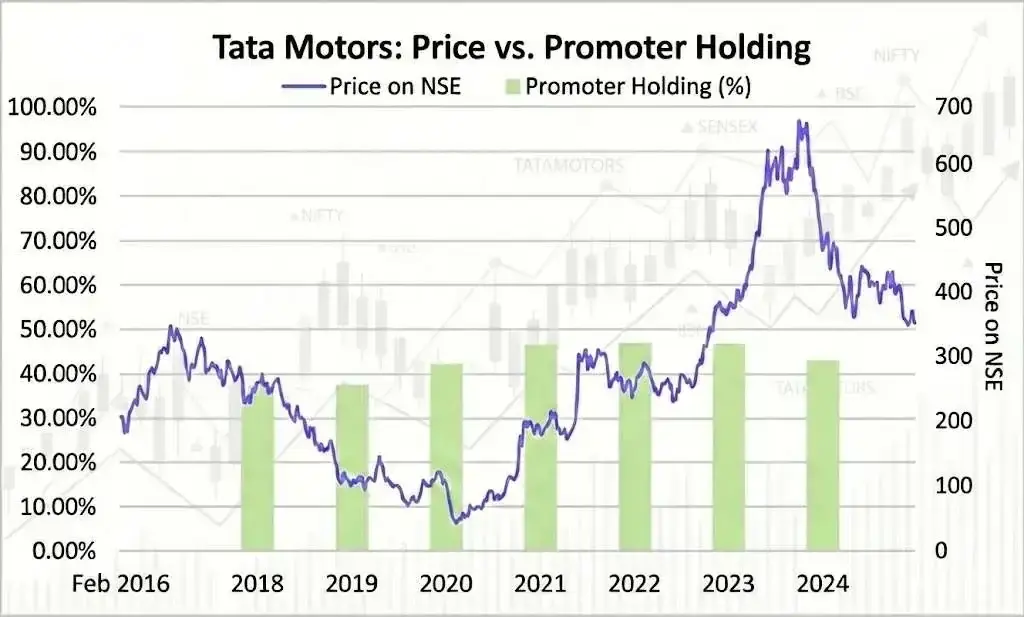
The Indian market gave us a textbook example of this in 2020 with the legacy giant, Tata Motors. At a time when the stock had crumbled to double digits (around ₹65) and the entire market was gripped by fear, the "experts" were busy predicting further doom. But amidst this noise, the company's promoters, “Tata Sons”, quietly started buying. They didn't panic; they saw value where everyone else saw risk, backing the country's best management with real cash.
“Insiders might sell their shares for many reasons, but they buy them for only one: they think the price will rise.” — Peter Lynch
This wasn't just a transaction; it was a loud signal of confidence that the market eventually had to respect. As the stock rallied from those lows to over ₹900, it proved that following the "smart money" often beats following the herd. While outsiders were guessing, the insiders knew the turnaround was coming. In this article, we’ll look at why this strategy works and how you can use this signal to spot the next big opportunity.
But before we go any further, let’s pause for a moment and understand what exactly promoter buying is, and why this single action carries so much weight in the market?
What Is Promoter Buying and Why It Matters
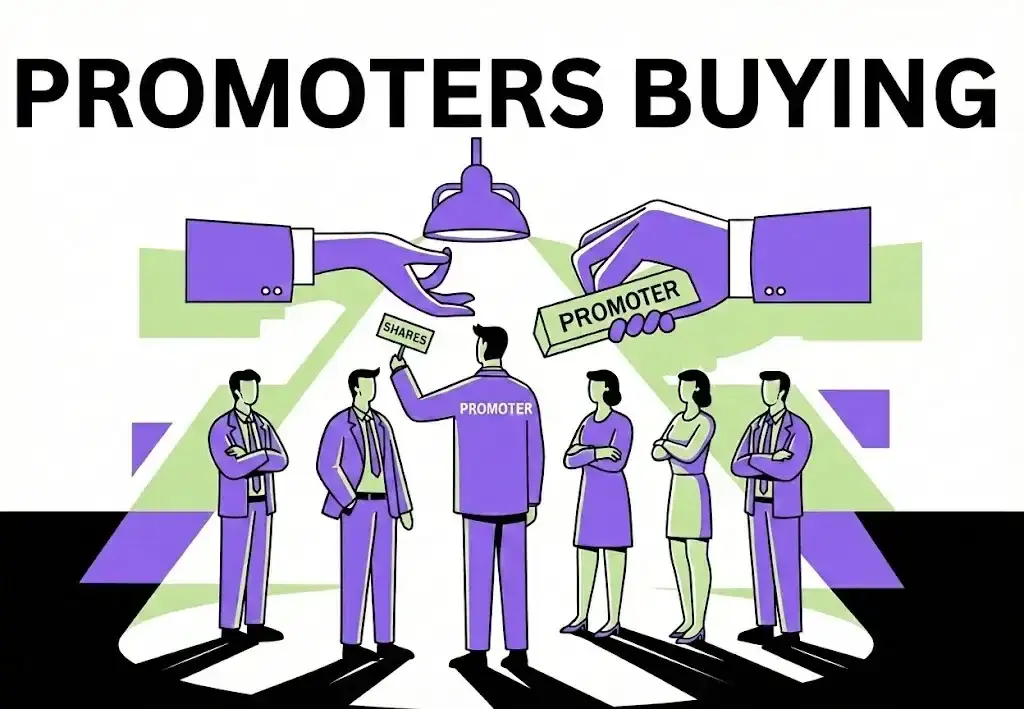
At its heart, promoter buying is the perfect display of confidence, a true act of "skin in the game." Simply put, "Promoter Buying" happens when the owners of a company use their own personal money to buy more shares of their company from the open market. Think of the promoter as the captain of the ship. When they dip into their personal savings to buy shares, they are doing far more than just making a financial transaction; they are sending a powerful message of conviction to the entire market that they believe in their own future.
For the company, this action sends a powerful message about its hidden potential. Promoters have a "God's eye view" of the business, they know the order book, the profit margins, and the future expansion plans long before the quarterly results are published on the news. If they are aggressively buying, it usually means they believe the market has undervalued their business and the current share price is a bargain. They aren't guessing like the analysts on TV; they are acting on concrete internal knowledge that the bad times are over and growth is ahead.
For us investors, this is the strongest safety net we can ask for. When a promoter increases their stake, they align their financial destiny with yours; they now suffer the same losses and enjoy the same gains as the minority shareholders. It removes the fear of fraud or lack of focus, because no rational business owner would throw good money into a sinking ship. Instead of blindly trusting tips, tracking this data allows you to "partner" with the most informed insiders, riding their conviction while they do the heavy lifting.
Understanding the definition is only half the story. The real power of promoter buying lies in when and why it happens, especially during moments of extreme fear. Let’s understand this through an example.
The Psychology Behind Promoter Buying
Great fortunes are rarely built on sunny days; they are often shaped in the middle of disasters when everyone else is panicking. The story of CG Power proves this perfectly: while the entire market fled from a massive fraud scandal, one quiet "Promoter Buy" signal set the stage for a legendary 70x return that most investors completely missed. Let’s understand the thinking behind this move through the classic case of CG Power’s fall and revival, a clear lesson in how insiders see opportunity when the rest of the world sees only destruction.In 2019, CG Power and Industrial Solutions faced every investor's worst nightmare: a massive corporate fraud. The news broke that the previous management had understated liabilities and misused company funds, causing the stock to crash violently from over ₹90 to single digits (around ₹8-9). Panic spread everywhere. Analysts labelled the company “uninvestable,” and retail investors rushed to exit, afraid the company would shut down. . It was the perfect storm of fear, where the "price" of the stock had collapsed, but the "value" of its factories and brand still remained hidden under the mess.
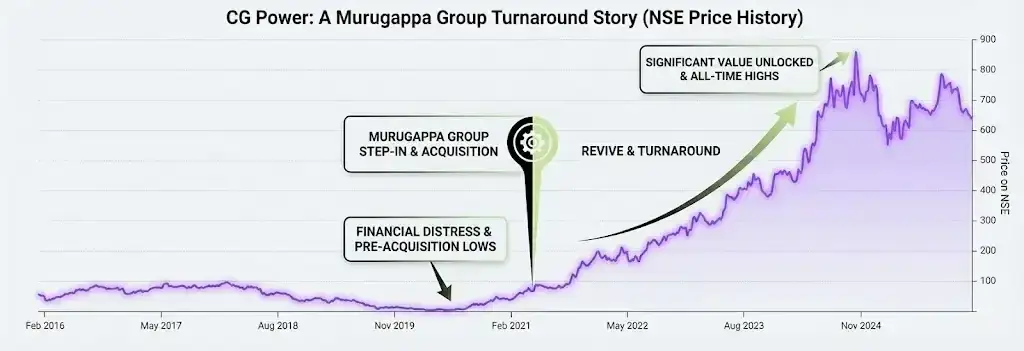
While the world saw a scam, the Murugappa Group (via Tube Investments) saw a goldmine. In 2020, instead of waiting for safety, they stepped in as the new promoters and injected roughly ₹750 crores of their own capital to buy a controlling stake at just ₹8.56 per share. This was the ultimate psychological signal: a highly respected business house was betting its reputation and hard cash on a "dead" company. They invested real cash, clearly showing their belief that the core business in motors and railways was strong and the problem was temporary.
“Great opportunities come disguised as unsolvable problems.”— Monish Pabrai
The investors who ignored the scary headlines and simply followed this "smart money" made life-changing wealth. From that desperate low of ~₹9 in 2020, the stock turned around and rallied all the way to over ₹700 by 2024, delivering returns of more than 70x in just a few years. The new promoters cleared the debt and restored trust, proving that when insiders aggressively buy during a crisis, they aren't gambling, rather they are capitalising on a certainty that outsiders cannot see. The CG Power story clearly shows that the biggest opportunities often hide inside the darkest fears, visible only to those who watch where promoters put their money, not what the news is shouting.
Read more: Common Traits of Every Multibagger Stock – Data-Based Study
Stories like CG Power are inspiring, but here’s the hard truth: not every promoter purchase leads to a happy ending. Knowing the difference is where skill beats luck. So let's decode the promoter buying signal, with a classic indian example.
Decoding Promoter Buying: Signal vs Noise
Imagine investing with the same confidence as the business owner himself. It is entirely possible if you know exactly what to look for. Here are five practical keys to help you separate empty noise from true golden signals, so you can stop guessing and start following the smart money today.1. Buying the Fear (The Valuation Gap)
Promoters are the ultimate smart shoppers; they love a bargain. When the market crashes or a sector falls out of favor, retail investors often panic and sell. However, a promoter uses this fear to buy back their own shares at a discount. If you see a promoter buying when the stock price is falling, it is usually the first sign that the bottom is near and the stock is undervalued.A classic example is Nippon Life India AMC. A few years ago, when the asset management sector was boring and the stock price was stagnant, the promoter (Nippon Life) kept increasing their stake quietly. They ignored the short-term noise because they knew the long-term potential. Investors who followed this quiet accumulation were rewarded handsomely as the stock eventually surged to new highs.
2. The "Crisis" Confidence
The best signal often comes when a company is facing a temporary crisis. When headlines are negative and analysts downgrade the stock, a promoter buying shares is a bold statement. It tells you, "The problems are fixable, and the market has overreacted." It takes immense courage to buy a falling knife, and when an insider does it, you should take it as a serious hint of safety.“The best indicator of management’s confidence is what they do with their own money.” — Philip Fisher
Look at Sun Pharma during its tough phase with US FDA observations a few years back. While the market hammered the stock due to regulatory fears, the promoter, Dilip Shanghvi, bought shares from the open market. He knew his business better than the panic-sellers. The company eventually resolved many issues, and the stock price recovered, proving that insider conviction is often more accurate than external fear.
3. The Power of Consistency (Creeping Acquisition)
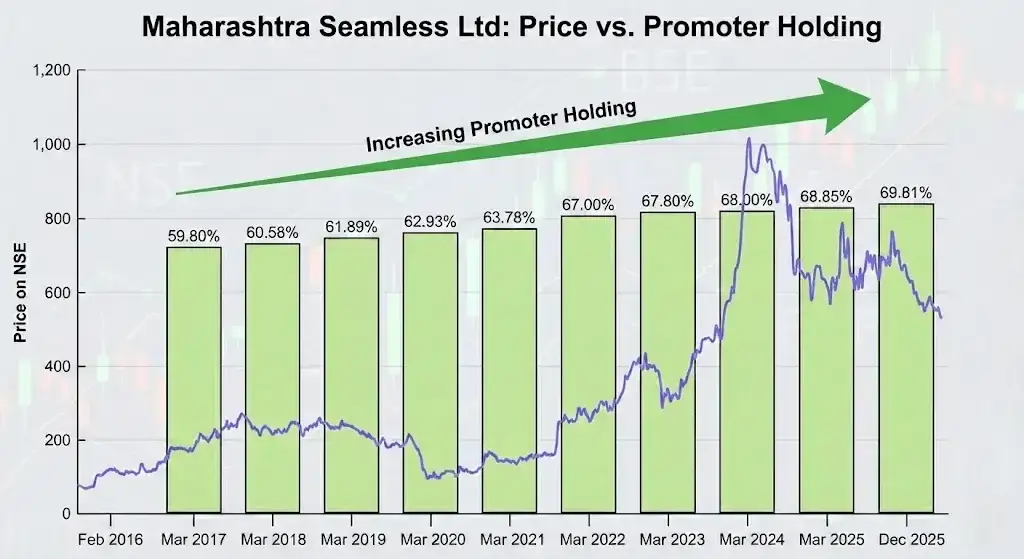
Don’t just look for a one-time big purchase; look for a pattern. The strongest signal is "creeping acquisition," where promoters buy small amounts of shares consistently every quarter. This shows they have sustained cash flow and a long-term belief that their stock is a better investment than anything else. It is like a systematic investment plan (SIP) by the owner, which builds massive trust.Maharashtra Seamless is a textbook example of this strategy. For several quarters, the promoters consistently bought shares from the open market, slowly increasing their holding. They didn't make a lot of noise, but the data was there for everyone to see. This consistent buying absorbed the supply in the market, and when the sector cycle turned, the stock price multiplied, creating huge wealth for those who noticed the pattern.
4. Signaling a Turnaround
Turnarounds are hard to predict, but promoters often know when the tide is turning before the financial results show it. If a company has had a few bad years and the promoter suddenly starts buying, it often means the internal metrics, like debt reduction or new order wins are improving. They position themselves to profit before the good news becomes public knowledge.A classic example is Himadri Speciality Chemical. After the stock had collapsed from its highs and remained stagnated for years, the market had largely written it off. Yet, the promoters aggressively bought shares from the open market, sensing that the business cycle was shifting. Investors who trusted this insider conviction over the market's negative talks, rode a massive multi-bagger rally as the company’s fortunes eventually revived.
Read more: 7 Early Signals That a Stock Can Turn Multibagger
5. The "Open Market" Authenticity Check
Not all promoter changes are buy signals. You must verify that the transaction is an actual "Open Market Purchase." Sometimes, promoters simply transfer shares between family members or receive them as gifts, which doesn't cost them any money. Real conviction is only proven when money leaves their bank account to buy shares from the public. Always check the "Mode of Acquisition" column in the exchange filings.A helpful contrast is to look at many family-run conglomerates where shares are just shifted from one holding company to another for tax purposes, this is neutral news. Compare this to a company like Bajaj Holdings, where the promoters have historically bought shares from the open market using real cash. This specific action of paying market price is what confirms they believe the stock is cheap, distinguishing a true signal from simple administrative paperwork.
Read more: Top Stocks with Heavy Promoter Buying in the Last 6 Months
Now that you know when promoter buying works, there’s one more critical skill left. Knowing when to walk away can, which can save you more money than knowing when to buy.
The Litmus Test: When to Ignore the Signal
Spotting a "Buy" signal is great, but knowing which one to trust is where the real money is made. Don't worry, you don't need a finance degree to distinguish the fake from the fortune-making signals. Use this simple safety checklist to filter out the traps and focus only on the winners.“Never trust someone who doesn’t have skin in the game.” — Nassim Nicholas Taleb
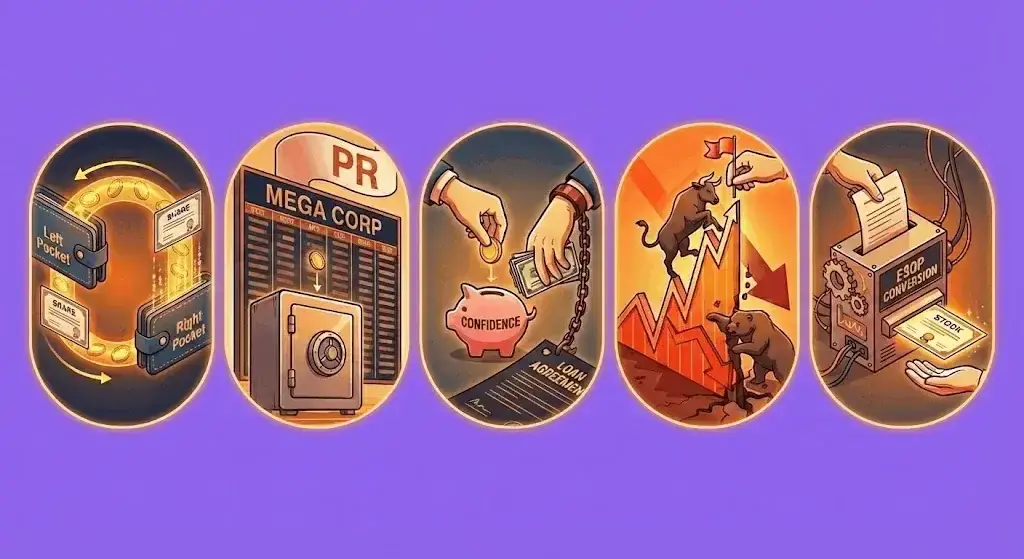
1. The "Inter-Promoter" Transfer: Always check who sold the shares. Often, you will see a headline saying, "Promoter bought 10 lakh shares." But when you dig deeper, you find that another promoter group entity sold 10 lakh shares. This is just money moving from the left pocket to the right pocket, usually for tax or family settlement purposes. It means nothing for the stock price.
2. The "Token Purchase" Trap: Beware of the "PR Buy." This happens when a promoter of a ₹5,000 crore company buys shares worth just ₹2 lakhs. It is mathematically irrelevant but creates a positive news headline to fool algorithms and retail investors.
3. The "Pledge" Paradox: This is the most dangerous trap. Sometimes, a promoter buys shares on one hand to show confidence, but simultaneously pledges their existing shares to raise loans on the other. This shows they are cash-strapped, not cash-rich.
Read more: Top Mid Cap Stocks with Zero Promoter Pledge
4. The "FOMO" Buy (Buying at Highs): Context is everything. If a promoter buys after the stock has already rallied 200% and is trading at an all-time high, be cautious. They might be trying to sustain the momentum artificially. The strongest signals come when the stock is beaten down, not when it is euphoric.
5. The "ESOP" Illusion: Sometimes, exchange filings show an increase in promoter holding, but the mode is listed as "Exercise of ESOPs" or "Conversion of Warrants." This is often a pre-planned compensation perk, not an active decision to buy at the current market price. Only trust the transaction if the column says "Open Market Purchase."
Once you remove the traps and false signals, what remains is a rare but powerful edge. And it can quietly change how you see the stock market forever. With this let’s now conclude this, with a quick summary of what you’ve read.
Read more: The Multibagger Framework: A Step-by-Step Guide to Finding 10x Stocks
Explore our Products
Research Framework

Emerging Titans
Combination of quantitative analysis, industry tailwinds, and management assessment - SPRINT investment philosophy

Tiny Titans
Heavy emphasis on scuttlebutt research, plant visits, and early on-ground signals
Conclusion: The Silent Signal of Success
“Play long-term games with long-term people.”— Naval RavikantIn a market obsessed with noise, breaking news, and quarterly drama, promoter buying is the only signal that cuts through the chaos. When the people who built the company decide to bet their own legacy on its future, they are seeing a picture that the rest of the market has missed.
Successful investing isn't about chasing every ticking price on the screen; it's about finding these rare moments of alignment. When you invest alongside a promoter who is buying, you stop being a spectator and start being a partner. You are no longer hoping for a lucky break; you are riding on the conviction of the person who knows the destination best. It turns the stock market from a casino into a calculated business decision.
If you are ready to stop guessing and start following the insiders who actually know the game, consider subscribing for more deep-dive frameworks. And if this article helped you understand why "skin in the game" matters more than headlines, drop a “PARTNER” in the comments. Let’s stop trading tickers and start owning businesses.
FAQs
Is promoter buying alone enough to invest in a stock?
+No. Promoter buying is a signal, not a guarantee. It should always be combined with basic checks like business quality, debt levels, and cash flow. Think of it as a green light to study deeper, not to invest blindly.
How much promoter buying is considered meaningful?
+Should I buy immediately after promoter buying is disclosed?
+Not necessarily. Promoter buying works best when paired with patience. Often, prices remain flat or volatile for months before the real move begins. This is a long-term signal, not a trading tip.
What if promoters buy but fundamentals look weak?
+How important is the promoter’s past track record?
+Very important. Promoters with a history of fair treatment to shareholders and clean governance deserve more trust than those with frequent dilution, pledging, or past controversies.

High growth stock specialist, Value Educator
Shashank Mahajan is an equity research professional with over 12 years of experience in identifying high-potential SME and micro-cap stocks at an early stage. He follows a rigorous scuttlebutt research–driven approach, combining on-ground insights with deep financial analysis. Shashank specializes in uncovering under-researched and under-owned companies with strong management quality and long-term growth potential. Through disciplined research and early identification, he focuses on spotting tomorrow’s market leaders before they enter the mainstream investor radar.

Zen Technologies: Revenue Fell After a Big Win




PNG Jewellers: A 194-Year-Old Name Goes National

Explore our Products
Research Framework
Emerging Titans
Combination of quantitative analysis, industry tailwinds, and management assessment - SPRINT investment philosophy
Tiny Titans
Heavy emphasis on scuttlebutt research, plant visits, and early on-ground signals


 Orders
 Subscription
 Share with friends
 Logout


Required Details
₹23999.00
(12 month subscription)
As per SEBI regulations, all users are mandated to complete the KYC that is validated for 1 year. Post payment, you will be redirected to the KYC screen


No comments yet. Be the first to comment!