
Power Sector Stocks in India 2026: List by Value Chain
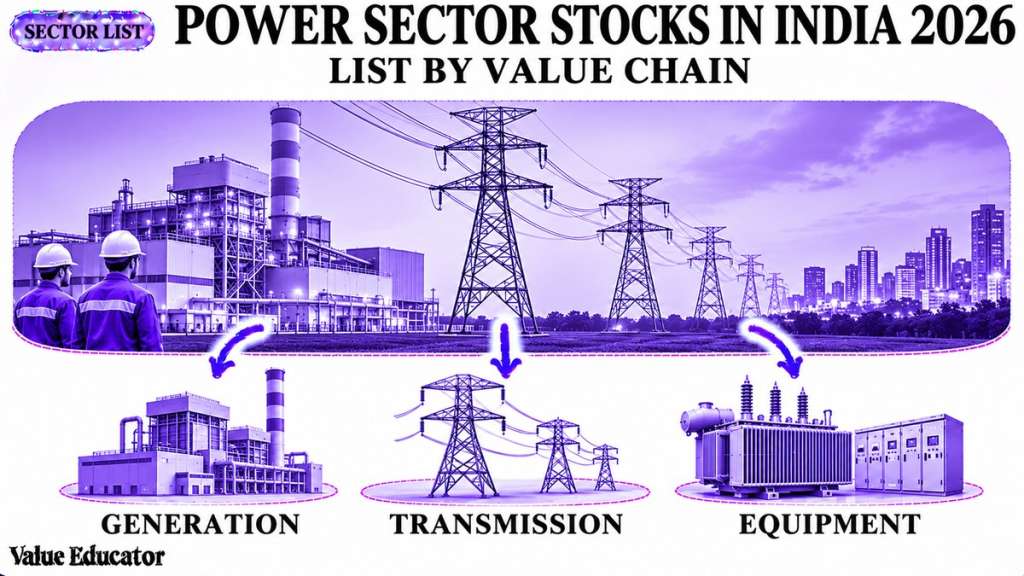
India is building out its power system on every side at once. In May 2026 the country met an all-time peak power demand of 271 GW, and demand is projected to rise towards 458 GW. To meet it, India plans more than 900 GW of non-fossil capacity by 2035-36, and all of that power has to travel on new lines, through new substations and transformers, to reach homes, factories and data centres.
That spending reaches a long chain of listed companies. This page lists the power companies we have studied in depth, grouped by where they sit in the value chain, with each company's latest order book and how many years of revenue it covers. Each row links to our full research on that company. The figures come from company filings and results calls, and the table is updated as new results come in.
Figures as of 20 November 2026. This page is research, not a recommendation to buy or sell any stock.
Power Sector Stocks in India at a Glance
The order book is the value of contracts a company has signed but not yet delivered. Dividing it by a year's revenue shows how many years of work are already in hand, if the company delivers on time.
| Company | Value chain | What it makes | Order book (date) | Order book ÷ FY26 revenue |
|---|---|---|---|---|
| Genus Power | Distribution and metering | Smart meters, and metering projects for power companies | ₹22,634 Cr (Sep 2026) | about 4.8x |
| Techno Electric | Transmission and substations | Substation and transmission EPC, data centres | ₹11,000 Cr (Aug 2026) | about 3.4x |
| Yash Highvoltage | Transmission and substations | Transformer bushings | over ₹760 Cr (30 Sep 2026) | about 3.2x |
| Power Mech Projects | Generation | Power plant erection, operation and maintenance, coal mining | ₹17,486 Cr excl. mining contracts; ₹56,729 Cr in all (Sep 2026) | about 2.9x (excl. mining) |
| Kalpataru Projects | Transmission and substations | Transmission line and substation EPC, plus buildings, pipelines and water works | ₹71,846 Cr, all businesses (30 Sep 2026) | about 2.6x |
| TARIL | Transmission and substations | Power transformers and reactors | ₹6,630 Cr unexecuted (Jun 2026) | about 2.6x |
| KPI Green Energy | Renewables | Builds solar and hybrid plants for companies, and owns plants that sell power | about ₹5,700 Cr of EPC orders (13 Nov 2026) | about 2.1x |
| Premier Energies | Renewables | Solar cells and modules | ₹16,260 Cr (Sep 2026) | about 2.0x |
| Quality Power | Transmission and substations | Reactors, HVDC equipment, battery-storage parts | ₹1,945.5 Cr (30 Jun 2026) | about 1.9x |
| Atlanta Electricals | Transmission and substations | Power transformers | ₹3,116.63 Cr (Jun 2026) | about 1.7x |
| Waaree Renewable Technologies | Renewables | Builds solar plants for other companies, and transmission lines | about ₹5,500 Cr (Sep 2026) | about 1.7x |
| INOX India | Plant and process equipment | Cryogenic tanks for LNG, hydrogen and industrial gases | ₹2,268 Cr (Sep 2026) | about 1.4x |
| K P Energy | Renewables | Builds everything around a wind turbine: land, roads, foundations and grid lines | 1.64 GW, about ₹1,940 Cr (Sep 2026) | about 1.3x |
| TD Power Systems | Generation | Generators for steam, gas and hydro turbines | ₹2,207.3 Cr (Jun 2026) | about 1.2x |
| KSB | Plant and process equipment | Pumps for nuclear and thermal plants, valves | ₹2,744.5 Cr, incl. ₹1,235 Cr nuclear (Jun 2026) | about 1.0x (calendar 2025 revenue) |
| Schneider Electric Infrastructure | Distribution and metering | Transformers, medium-voltage switchgear and ring main units | ₹2,701 Cr backlog (30 Sep 2026) | about 0.9x |
| Kirloskar Brothers | Plant and process equipment | Pumps for power plants, water supply, irrigation and nuclear | ₹4,062.2 Cr (30 Jun 2026) | about 0.9x |
| Kilburn Engineering | Plant and process equipment | Dryers, heavy-water plant equipment, waste heat recovery | ₹470 Cr (Sep 2026) | about 0.7x |
| Elecon Engineering | Plant and process equipment | Gearboxes and material handling equipment for power, steel and cement plants | ₹1,635 Cr (30 Sep 2026) | about 0.7x |
| APAR Industries | Transmission and substations | Conductors, cables, transformer oils | ₹12,025 Cr conductors + ₹3,012 Cr cables (Sep 2026) | about 0.7x |
| Shakti Pumps | Renewables | Solar water pump sets for farmers | ₹751 Cr (23 Oct 2026) | about 0.3x |
| Inox Wind | Renewables | Wind turbines | about 3.8 GW (Oct 2026) | - |
| KSH International | Transmission and substations | Winding wires for transformers and motors | Not disclosed | - |
| Kirloskar Oil Engines | Generation | Engines and gensets for data centres, industry, nuclear and navy | Not disclosed | - |
| Borosil Renewables | Renewables | Glass for the front of solar panels | Not disclosed | - |
| Servotech Renewable | Renewables | Solar inverters, rooftop solar plants and EV chargers | Not disclosed | - |
Quality Power's and TD Power's ratios use total income, and Premier Energies' uses total revenue; KSB reports on a January-December year. APAR's order books turn into revenue quickly, so a lower ratio is normal for it. Power Mech's ratio leaves out ₹39,243 Cr of mine developer and operator (MDO) contracts, under which it runs two coal mines for decades. Kalpataru's order book covers all its businesses, of which power transmission and distribution is 41%. KPI Green's figure counts only its plant-building (EPC) orders. Inox Wind reports its order book in gigawatts (GW) of turbines, not in rupees, so it has no ratio.
Power Stocks by Value Chain
Generation Equipment
Every power plant needs machines to turn fuel, steam or water into electricity. TD Power Systems makes the generators that sit behind steam, gas and hydro turbines, and now sells power plants to data centres. Kirloskar Oil Engines makes engines and gensets that keep data centres, factories and ships running when the grid fails. Power Mech Projects erects power plants and then runs and maintains them for their owners; it also runs two coal mines under long contracts.
Transmission and Substations
New power has to travel. Techno Electric builds substations and transmission projects and is moving into data centres. Kalpataru Projects builds transmission lines and substations in India and abroad, alongside buildings, pipelines and water works. APAR Industries makes the conductors and cables that carry the power, and exports a large share. Atlanta Electricals and TARIL make the power transformers that step voltage up and down, KSH International makes the winding wire inside those transformers, and Yash Highvoltage makes the bushings that carry current into them. Quality Power makes reactors and equipment for high-voltage DC lines and battery storage.
Distribution and Metering
Power finally has to reach homes, shops and factories. Genus Power makes smart meters, which send each reading to the power company on their own, and runs metering projects for power companies. Schneider Electric Infrastructure makes transformers, medium-voltage switchgear and ring main units that step down and switch power for utilities, factories and data centres.
Plant and Process Equipment
Power plants also need pumps, tanks, gearboxes and heat equipment. KSB makes pumps for nuclear and thermal plants, including reactor coolant pumps for NPCIL. Kirloskar Brothers makes pumps that cool the steam in thermal power plants, and has supplied sodium pumps for BHAVINI's fast breeder reactor. Elecon Engineering makes gearboxes and material handling equipment; a thermal plant needs both, for its coal yard and its mills. Kilburn Engineering makes equipment for heavy-water plants and waste heat recovery. INOX India makes cryogenic tanks for LNG, hydrogen and industrial gases.
Renewable Energy
Solar and wind plants make up a growing share of new capacity. Premier Energies makes solar cells and modules, Borosil Renewables makes the glass that covers solar panels, and Inox Wind makes wind turbines. Waaree Renewable Technologies, KPI Green Energy and K P Energy build solar and wind plants for other companies. Shakti Pumps makes solar water pumps for farmers, and Servotech makes solar inverters and EV chargers. Our renewable energy stocks page covers this chain in more detail.
Why Power Stocks Are Rising
Demand keeps setting records. India met an all-time peak demand of 271 GW in May 2026, and demand is projected to rise towards 458 GW. Factories, air conditioning, electric vehicles and data centres all add to it.
Renewables need new lines. India plans more than 900 GW of non-fossil capacity by 2035-36, about 548 GW of it from solar and wind. Solar and wind farms are far from the cities that use the power, so each gigawatt needs new transmission lines, substations and transformers. That is why transmission equipment makers hold some of the largest order books relative to revenue.
Storage is the next wave. India's Central Electricity Authority expects the country to need about 236 GWh of battery storage by 2031-32, and about 102 GWh of battery-storage tenders were issued in 2025 alone.
Data centres want reliable power. Data centres need steady power and backup, which brings orders for transformers, cables, gensets and generators, and for the companies that build their substations.
Exports are growing. Several Indian equipment makers now sell large shares abroad, especially to the US and Europe, where grids are being rebuilt too.
Other Listed Power Companies
Some power companies are covered in our theme articles rather than a single deep dive:
| Company | Value chain | Where we cover it |
|---|---|---|
| NTPC, JSW Energy | Power generation | NTPC vs JSW Energy |
| Waaree Energies | Solar modules | Solar company research |
| Shilchar Technologies | Transformers | Shilchar research |
| Universal Cables | Cables | Universal Cables research |
| SPML Infra | Water and battery storage | SPML Infra research |
| Power companies with big capex plans | Various | Power stocks with big capex plans |
How to Read a Power Company's Order Book
- How firm is it? Signed purchase orders are different from letters of award or framework agreements.
- How fast does it turn into revenue? Transformer and cable orders deliver within months to a couple of years; EPC and nuclear orders can take several years.
- Who is the customer? State utilities can delay tenders and pay late. Private developers and exporters usually pay faster.
- Are raw material costs passed on? Copper, aluminium and steel prices move fast. Check whether contracts let the company pass on cost changes.
- Is capacity keeping up? A big order book is only useful if the factory can deliver it. Watch capacity additions and their timing.
PSU or Private Power Stocks?
Public sector power companies such as NTPC and Power Grid own large generation and transmission assets, earn regulated returns and usually pay steady dividends. Private equipment makers and contractors are smaller, grow faster with each order cycle, and tend to reinvest more of their profit into new capacity. The first group suits investors who want steady income; the second depends on order wins and execution.
Key Risks for Power Stocks
- Tender timing: utilities and developers can delay awards, leaving gaps between orders.
- Raw material prices: copper, aluminium and steel swings can squeeze margins on fixed-price orders.
- Execution: delays in new plants or project sites push revenue into later years.
- Customer concentration: a few large utilities and developers place most orders.
- Valuations: when power stocks are in favour, prices can run ahead of what the order books can deliver.
Explore our Products
Research Framework

Emerging Titans
Combination of quantitative analysis, industry tailwinds, and management assessment - SPRINT investment philosophy

Tiny Titans
Heavy emphasis on scuttlebutt research, plant visits, and early on-ground signals
Companies Compared Side by Side
For a closer look at companies on this list, these pages set them against each other on order books, margins, cash flow and balance sheets:
- Kalpataru Projects vs KEC International: T&D EPC Compared
- Genus Power vs HPL Electric: Smart Meter Makers Compared
- Inox Wind vs Suzlon: Wind Turbine Makers Compared
- Premier Energies vs Waaree Energies: Solar Makers Compared
Conclusion
Power demand, renewable capacity and storage plans all point to years of spending on India's grid, and order books across the equipment chain are at or near records. But an order book is only as good as its delivery. Use the table above to see where each company stands, then read our research on each one for its delivery record, margins and risks.
FAQs
Which are the top power sector stocks in India for 2026?
+India's power companies range from large utilities such as NTPC and Power Grid to equipment makers and contractors. The table on this page lists the companies we have researched, with each one's order book and how many years of revenue it covers. We do not rank stocks as buys; read each company's research for its risks.
Why are power stocks rising?
+Peak power demand reached a record 271 GW in May 2026, India plans more than 900 GW of non-fossil capacity by 2035-36, and battery storage and data centres add new demand. All of this needs new lines, transformers and equipment, which has filled the order books of power equipment makers.
Which power companies have the biggest order books compared with revenue?
+Among the companies we cover, Genus Power (about 4.8 times FY26 revenue), Techno Electric (about 3.4 times) and Yash Highvoltage (about 3.2 times) had the largest order books relative to revenue in our latest data.
Which companies make transformers in India?
+Listed transformer makers we cover include TARIL, Atlanta Electricals, Schneider Electric Infrastructure and Shilchar Technologies. KSH International makes the winding wire used inside transformers, and Yash Highvoltage makes transformer bushings.
Are PSU or private power stocks better?
+PSU utilities usually offer steady dividends and regulated returns; private equipment makers usually offer faster growth with more dependence on order wins. The choice depends on what an investor wants and on each company's numbers.
Do power stocks pay dividends?
+Many power utilities pay regular dividends. Equipment makers that are adding capacity tend to pay smaller dividends and reinvest more of their profit.

High growth stock specialist, Value Educator
Shashank Mahajan is an equity research professional with over 12 years of experience in identifying high-potential SME and micro-cap stocks at an early stage. He follows a rigorous scuttlebutt research–driven approach, combining on-ground insights with deep financial analysis. Shashank specializes in uncovering under-researched and under-owned companies with strong management quality and long-term growth potential. Through disciplined research and early identification, he focuses on spotting tomorrow’s market leaders before they enter the mainstream investor radar.
More about Shashank Mahajan →
PCBL Chemical: Carbon Black Margins and Battery Materials
KEC International: Record Orders, Weak Margin, High Debt
Sona BLW: EV Revenue Now Tops Half of Its Auto Sales
HPL Electric & Power: Smart Meters, Wires and Two Engines
Kaynes Technology: EMS, Chip Plants and ₹10,563.5 Cr Orders
Sterlite Technologies: Glass Rods to Hyperscaler Deals
Explore our Products
Research Framework
Emerging Titans
Combination of quantitative analysis, industry tailwinds, and management assessment - SPRINT investment philosophy
Tiny Titans
Heavy emphasis on scuttlebutt research, plant visits, and early on-ground signals



India's Aerospace Opportunity
Global Demand. Supply Bottlenecks. Opportunities Ahead.
Don't Miss This Exclusive Webinar!
Join Value Educator to decode the key trends shaping India's aerospace sector and learn how to identify tomorrow's potential leaders in the space.
- How the aircraft value chain works, layer by layer
- Indian companies supplying global aircraft makers
- A framework to judge any aerospace company

 Orders
 Subscription
 Share with friends


Required Details
₹23999.00
(12 month subscription)
As per SEBI regulations, all users are mandated to complete the KYC that is validated for 1 year. Post payment, you will be redirected to the KYC screen


No comments yet. Be the first to comment!